We use cookies to ensure our site functions properly and to store limited information about your usage. You may give or withdraw consent at any time. To find out more, read our privacy policy and cookie policy.
Manage Cookies
A cookie is information stored on your computer by a website you visit. Cookies often store your settings for a website, such as your preferred language or location. This allows the site to present you with information customized to fit your needs. As per the GDPR law, companies need to get your explicit approval to collect your data. Some of these cookies are ‘strictly necessary’ to provide the basic functions of the website and can not be turned off, while others if present, have the option of being turned off. Learn more about our Privacy and Cookie policies. These can be managed also from our cookie policy page.
Strictly necessary cookies(always on):
Necessary for enabling core functionality. The website cannot function properly without these cookies. This cannot be turned off. e.g. Sign in, Language
Analytics cookies:
Analytical cookies help us to analyse user behaviour, mainly to see if the users are able to find and act on things that they are looking for. They allow us to recognise and count the number of visitors and to see how visitors move around our website when they are using it. Tools used: Google Analytics
This chapter sets out design and planning guidance for the most common types of household alterations and extensions. It also includes retrofit measures that you could consider to reduce your household running costs.
Undertaking a home extension or alteration can be a great way to introduce more space, light or functionality into your home. However, it is essential to have a well thought-out design that complies with regulations. Some of the alterations in this chapter be carried out for flats, depending on whether the dwelling is located on the ground floor or an upper floor.
It should be noted that different permitted development rights apply for flats and maisonettes, for details refer to this page on the Planning Portal.
For information about the guidance on this page and how it should be interpreted and applied, visit Using this SPD.
Local Plan Context:
Policy 8 - Character-Led Intensification
Policy 16 - Accessible and Adaptable Housing
Policy 53 - Delivering High Quality Design
Policy 56 - Residential Space Standards
Policy 57 - Amenity
Policy 87 - Sustainable Design and Construction
7.1 General guidance
7.1.1
Certain alterations and extensions are classed as permitted development and do not require planning permission. For details of permitted development rights for a range of home extensions and alterations, refer to this page on the Planning Portal.
Where proposals deviate from the guidance within this chapter, the Council will need to be satisfied that proposals are of exemplar quality and not detrimental to neighbourhood amenity. Pre-application submission is encouraged.
7.1.4
For any proposals where protected species or their habitats may be affected by development, an ecological survey must be carried out. This can include (but is not limited to) rear extensions, side extensions, the demolition of existing structures, and works to roofs or lofts. Further information on protected species can be found here.
7.2 Building footprint
7.2.1
All extensions and alterations should consider the proportion of extension to the existing garden, as an increase in hard landscaping can increase the risk of surface water flooding.
7.2.2
Policy 53 of the Local Plan, ‘Delivering High Quality Design’ emphasises the importance of design measures that support surface water management. Find further information on mitigating surface water run-off here.
7.2.3
New structures or hardstanding must be at least 8m from the top of the bank of a main river, or 5m if an ordinary watercourse, as noted in Policy 83 of the Local Plan , ‘Protecting and Enhancing Waterways and River Corridors’.
7.3 Privacy
7.3.1
All extensions and alterations must be designed to ensure that the privacy of neighbours is respected. This includes neighbouring properties and neighbouring gardens. This is supported by Policy 57 of the Local Plan, ‘Amenity’.
7.4 Sunlight and daylight
7.4.1
Proposals must ensure that the extension would not significantly overshadow neighbouring habitable room windows or private gardens to an unacceptable degree. This is supported by Policy 57 of the Local Plan, ‘Amenity’.
7.4.2
All proposals should seek to minimise overshadowing or blocking of light to adjoining properties.
7.4.3
In assessing the impact and acceptability of proposed extensions, the Council will use the 25-degree and 45-degree tests. These are rules are used to assess the impact on amenity of neighbours.
7.4.4
While the 25-degree test considers the proposal section, the 45-degree test considers the proposal in plan and elevation.
7.4.5
Both of the following tests should be demonstrated in any planning application for an extension:
25-degree test (in section).
45-degree test (in plan and elevation).
25-degree test
The 25-degree test considers the impact of a new building on the daylight levels of neighbouring windows facing the proposed development.
It applies to single and multiple storey extensions, and is carried out using a section drawing of the proposal and neighbouring buildings.
Section
When a 25-degree line is drawn from the centre of the lowest ground floor window of a neighbouring building, the proposed development should not exceed this line in height. The centre of the lowest ground floor window can typically be assumed to be 2m above ground level.
If the proposed building protrudes above the 25 degree line in any way, it is likely that further tests will be required to establish the exact impact the proposed development would have on daylight to the existing property.
The test is only applied to the principal windows in habitable rooms such as the living room, dining room and bedrooms.
25-degree rule drawn in elevation. When a 25-degree line is drawn from the centre of the lowest ground floor window of a neighbouring building, the proposed development should not exceed this line in heigh (First in Architecture)
45-degree test
The 45-degree test is used to consider the impact of an extension to a neighbouring window that is perpendicular to the proposed development. It can be used for directly neighbouring and terraced dwellings.
The 45-degree test applies to single and multiple storey extensions, and is carried out in plan and elevation. If a proposal does not pass the 45-degree test in plan or elevation, further technical assessment will be recommended.
Plan
In plan, a 45-degree angle line is drawn from the outer corner of the proposed development/extension towards the neighbouring window that may be affected.
The diagonal line should not protrude beyond the centre of this window.
45-degree rule drawn in plan. When a 45-degree line is drawn from the centre of a neighbouring window, the proposed development/extension should not protrude beyond this line (First in Architecture)
Elevation
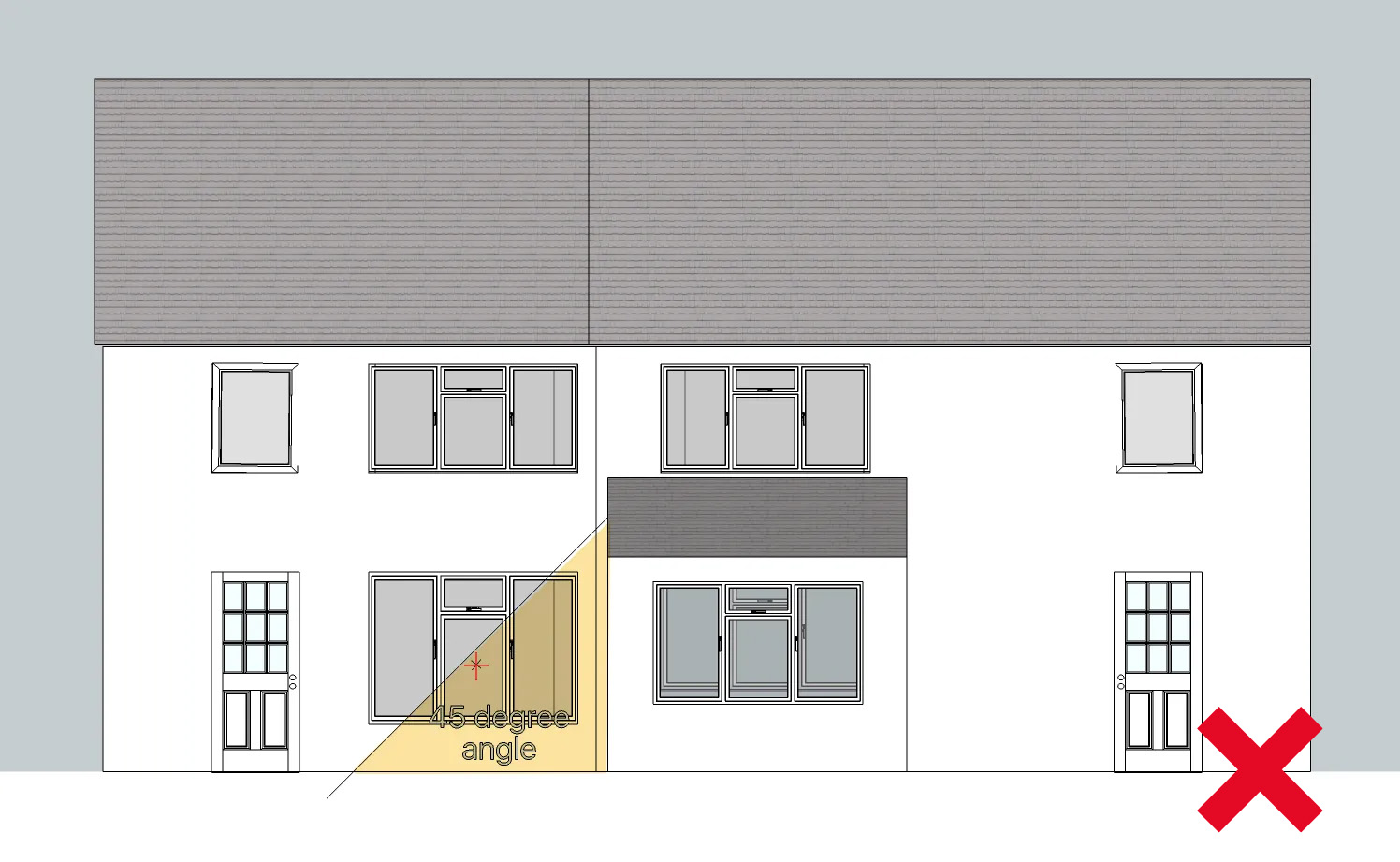
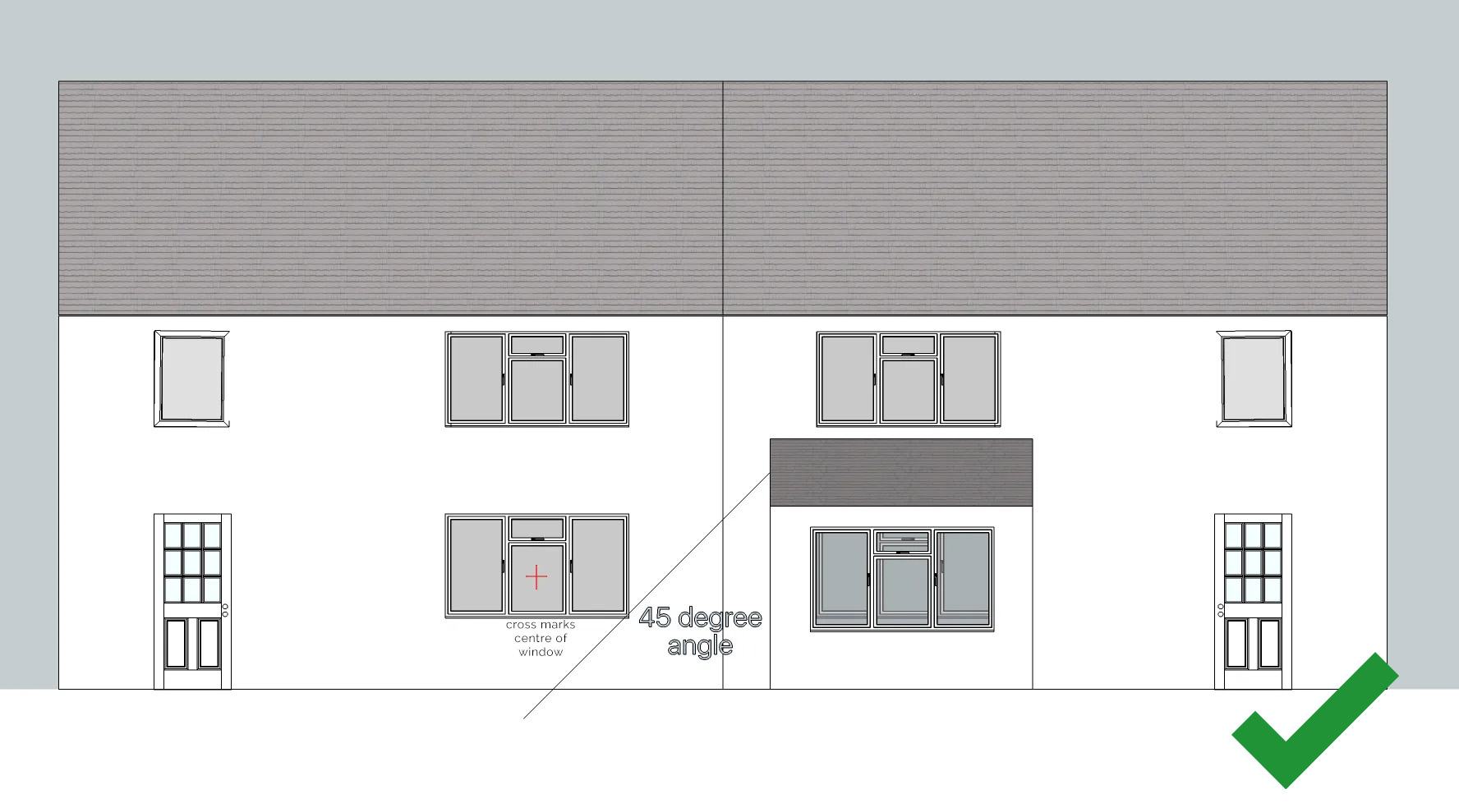
In elevation, a point is marked in the middle of the neighbouring window that may be affected. If this is a full height window or patio door, the point should be marked at 2m above ground level.
A 45-degree angle line is drawn from the roof edge of the proposed extension towards the neighbouring window. If the roof is sloping, the line should be taken from half way down the roof slope.
This line should fall below the point marked on the neighbouring window.
45-degree rule drawn in elevation. When a 45-degree line is drawn from the roof edge of the proposed extension, this should fall below the centre of the neighbouring window (First in Architecture)
This chapter sets out design and planning guidance for the most common types of household alterations and extensions. It also includes retrofit measures that you could consider to reduce your household running costs.
Undertaking a home extension or alteration can be a great way to introduce more space, light or functionality into your home. However, it is essential to have a well thought-out design that complies with regulations. Some of the alterations in this chapter be carried out for flats, depending on whether the dwelling is located on the ground floor or an upper floor.
It should be noted that different permitted development rights apply for flats and maisonettes, for details refer to this page on the Planning Portal.
For information about the guidance on this page and how it should be interpreted and applied, visit Using this SPD.
Local Plan Context:
Policy 8 - Character-Led Intensification
Policy 16 - Accessible and Adaptable Housing
Policy 53 - Delivering High Quality Design
Policy 56 - Residential Space Standards
Policy 57 - Amenity
Policy 87 - Sustainable Design and Construction
7.1 General guidance
7.1.1
Certain alterations and extensions are classed as permitted development and do not require planning permission. For details of permitted development rights for a range of home extensions and alterations, refer to this page on the Planning Portal.
Where proposals deviate from the guidance within this chapter, the Council will need to be satisfied that proposals are of exemplar quality and not detrimental to neighbourhood amenity. Pre-application submission is encouraged.
7.1.4
For any proposals where protected species or their habitats may be affected by development, an ecological survey must be carried out. This can include (but is not limited to) rear extensions, side extensions, the demolition of existing structures, and works to roofs or lofts. Further information on protected species can be found here.
7.2 Building footprint
7.2.1
All extensions and alterations should consider the proportion of extension to the existing garden, as an increase in hard landscaping can increase the risk of surface water flooding.
7.2.2
Policy 53 of the Local Plan, ‘Delivering High Quality Design’ emphasises the importance of design measures that support surface water management. Find further information on mitigating surface water run-off here.
7.2.3
New structures or hardstanding must be at least 8m from the top of the bank of a main river, or 5m if an ordinary watercourse, as noted in Policy 83 of the Local Plan , ‘Protecting and Enhancing Waterways and River Corridors’.
7.3 Privacy
7.3.1
All extensions and alterations must be designed to ensure that the privacy of neighbours is respected. This includes neighbouring properties and neighbouring gardens. This is supported by Policy 57 of the Local Plan, ‘Amenity’.
7.4 Sunlight and daylight
7.4.1
Proposals must ensure that the extension would not significantly overshadow neighbouring habitable room windows or private gardens to an unacceptable degree. This is supported by Policy 57 of the Local Plan, ‘Amenity’.
7.4.2
All proposals should seek to minimise overshadowing or blocking of light to adjoining properties.
7.4.3
In assessing the impact and acceptability of proposed extensions, the Council will use the 25-degree and 45-degree tests. These are rules are used to assess the impact on amenity of neighbours.
7.4.4
While the 25-degree test considers the proposal section, the 45-degree test considers the proposal in plan and elevation.
7.4.5
Both of the following tests should be demonstrated in any planning application for an extension:
25-degree test (in section).
45-degree test (in plan and elevation).
25-degree test
The 25-degree test considers the impact of a new building on the daylight levels of neighbouring windows facing the proposed development.
It applies to single and multiple storey extensions, and is carried out using a section drawing of the proposal and neighbouring buildings.
Section
When a 25-degree line is drawn from the centre of the lowest ground floor window of a neighbouring building, the proposed development should not exceed this line in height. The centre of the lowest ground floor window can typically be assumed to be 2m above ground level.
If the proposed building protrudes above the 25 degree line in any way, it is likely that further tests will be required to establish the exact impact the proposed development would have on daylight to the existing property.
The test is only applied to the principal windows in habitable rooms such as the living room, dining room and bedrooms.
25-degree rule drawn in elevation. When a 25-degree line is drawn from the centre of the lowest ground floor window of a neighbouring building, the proposed development should not exceed this line in heigh (First in Architecture)
45-degree test
The 45-degree test is used to consider the impact of an extension to a neighbouring window that is perpendicular to the proposed development. It can be used for directly neighbouring and terraced dwellings.
The 45-degree test applies to single and multiple storey extensions, and is carried out in plan and elevation. If a proposal does not pass the 45-degree test in plan or elevation, further technical assessment will be recommended.
Plan
In plan, a 45-degree angle line is drawn from the outer corner of the proposed development/extension towards the neighbouring window that may be affected.
The diagonal line should not protrude beyond the centre of this window.
45-degree rule drawn in plan. When a 45-degree line is drawn from the centre of a neighbouring window, the proposed development/extension should not protrude beyond this line (First in Architecture)
Elevation
In elevation, a point is marked in the middle of the neighbouring window that may be affected. If this is a full height window or patio door, the point should be marked at 2m above ground level.
A 45-degree angle line is drawn from the roof edge of the proposed extension towards the neighbouring window. If the roof is sloping, the line should be taken from half way down the roof slope.
This line should fall below the point marked on the neighbouring window.
45-degree rule drawn in elevation. When a 45-degree line is drawn from the roof edge of the proposed extension, this should fall below the centre of the neighbouring window (First in Architecture)
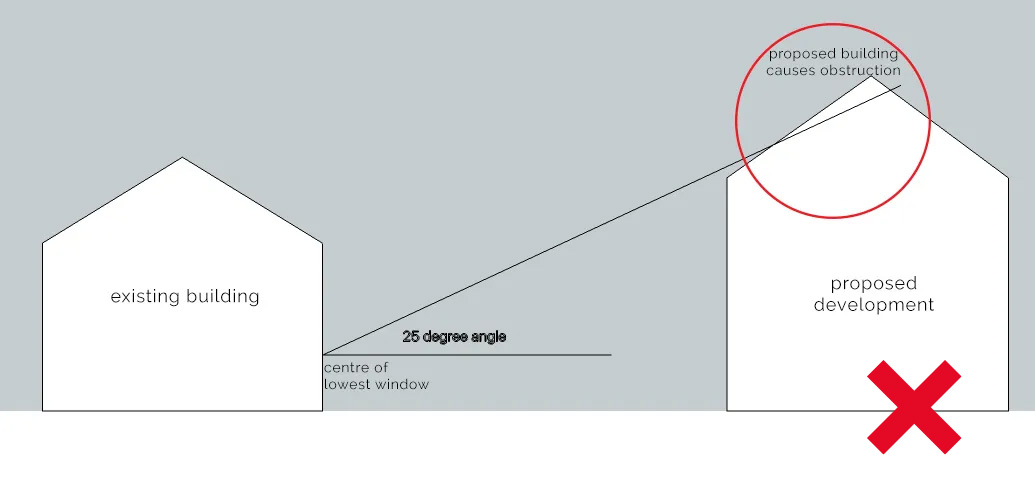
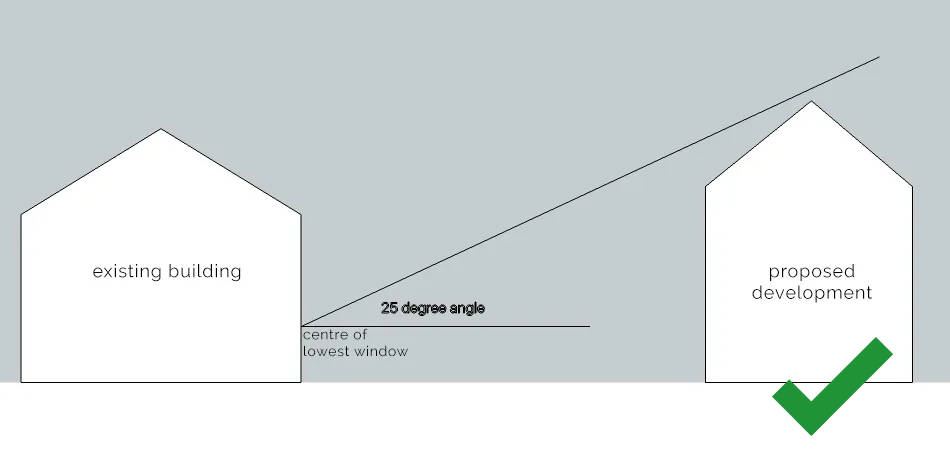 25-degree rule drawn in elevation. When a 25-degree line is drawn from the centre of the lowest ground floor window of a neighbouring building, the proposed development should not exceed this line in heigh (First in Architecture)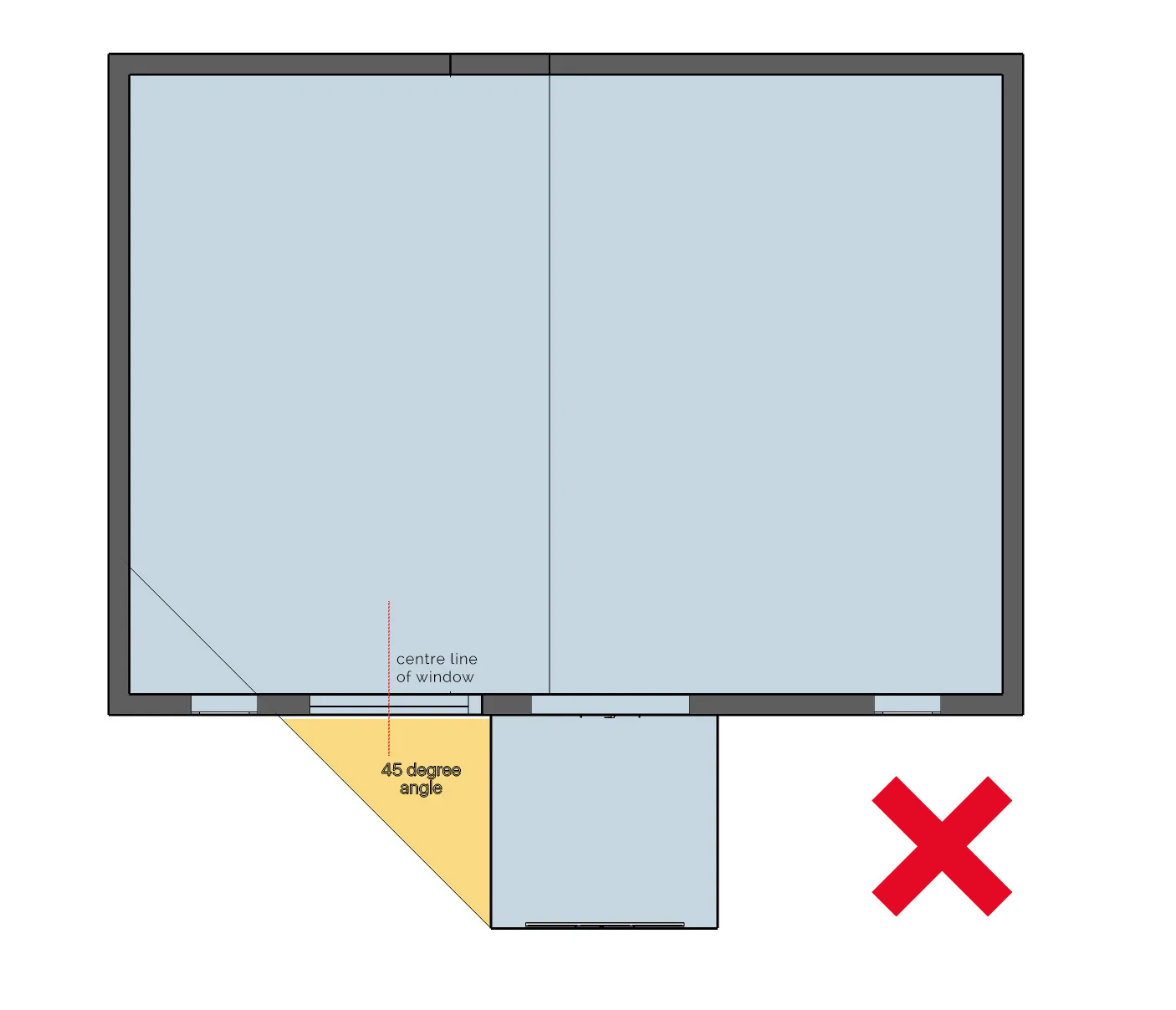
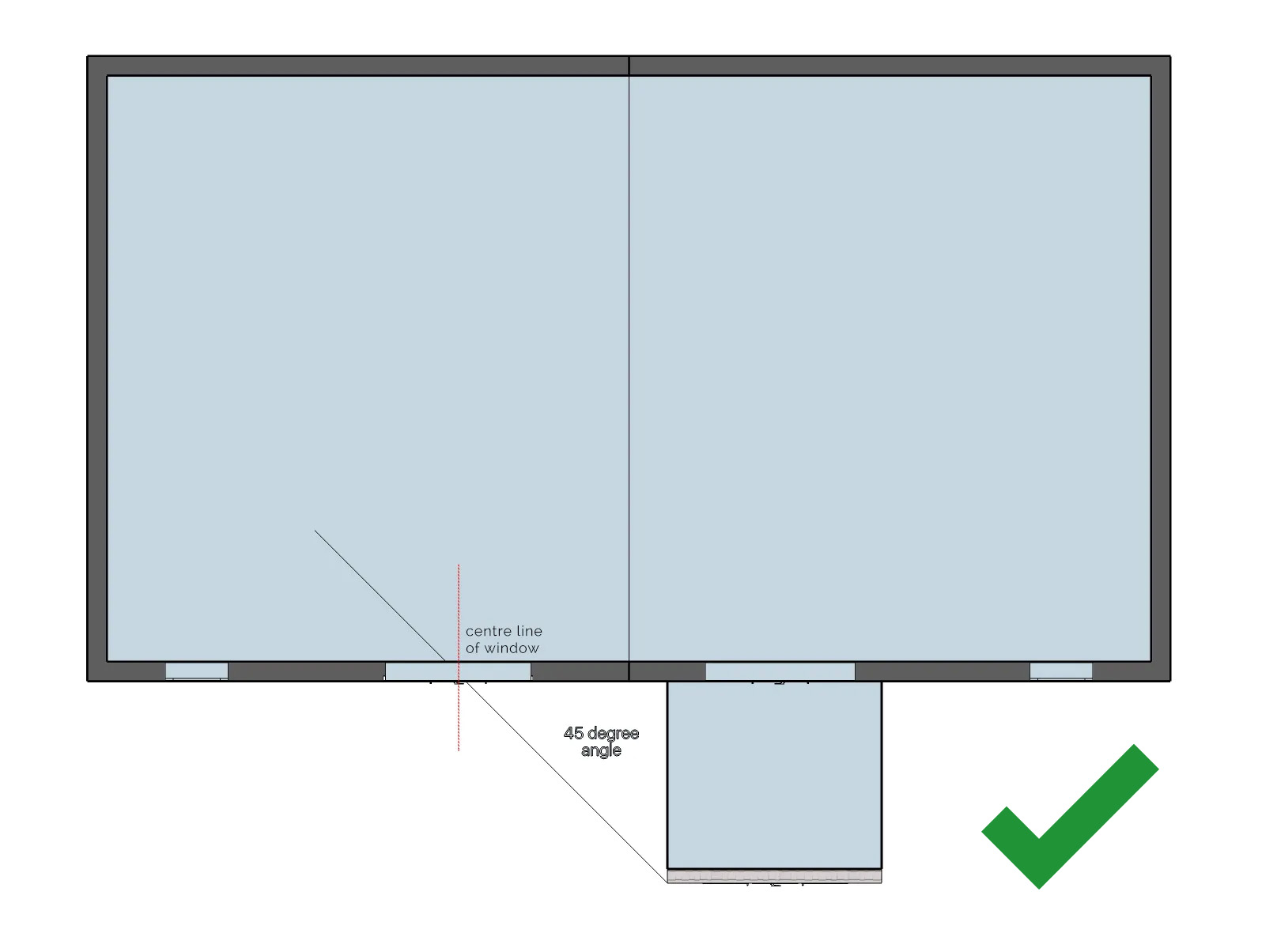 45-degree rule drawn in plan. When a 45-degree line is drawn from the centre of a neighbouring window, the proposed development/extension should not protrude beyond this line (First in Architecture)