11.5 Habitats
You can create habitats in your garden by making a series of small changes, which may be planted or non-greening elements. Some easy ways to introduce habitats in your garden include:
- Installing bird feeders and nesting boxes affixed to trees in your garden can attract a variety of birds, which in turn helps to control insect populations.
- Work with neighbours to create a “hedgehog highway” at ground level by incorporating small gaps at the base of fences. Consider introducing mixed native hedgerows along property boundaries.
- Even a pile of logs in your garden can serve as a brilliant habitat for wildlife. A log pile left to decay can provide shelter, food, and breeding spots for insects, amphibians and small mammals.
Trees, hedges and planting
| 11.5.1 | Trees, hedges and planting, even if not regularly maintained, have biodiversity value. It is important to retain these elements where possible, in order to not disrupt existing wildlife.
|
|
| 11.5.2 | Residents are encouraged to create a wildflower meadow can help to support bees, butterflies, and other pollinators.
|
|
| 11.5.3 | Residents are encouraged to allow a portion of the garden to grow freely or to avoid mowing during Spring. Mowing less often or leaving a small area uncut helps to provide habitats for insects and food for pollinators.
|
|
| 11.5.4 | ‘No Mow May’ is a conservation campaign started by Plantlife, which urges gardeners to avoid mowing during May each year, helping to support garden biodiversity.
|
|
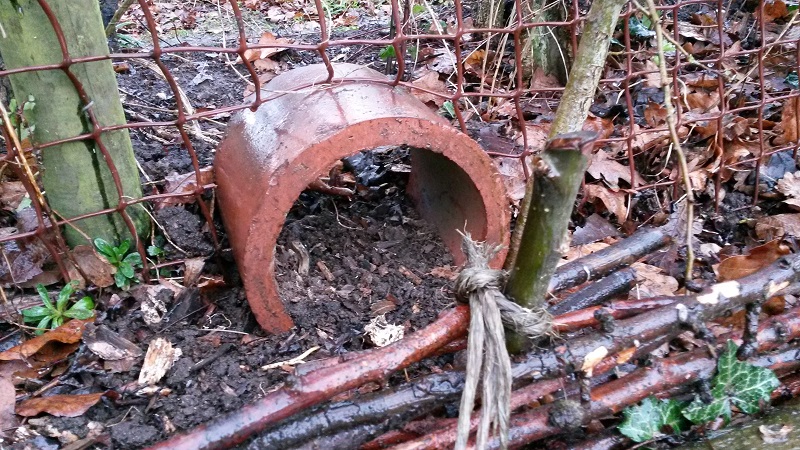 Sustainable hedgehog highway made from a recycled section of ceramic pipe
Ponds and waterways
A pond can be a great addition to a garden, creating a focal point and bringing wildlife and tranquillity to the space. Garden ponds can help to regulate the microclimate, create a thriving ecosystem for wildlife, reduce rainwater runoff and help to replenish local groundwater.
| 11.5.5 | When introducing a garden pond consider the following: - location within the garden.
- the shape and size.
- ensure a pond liner is used, or a pre-formed pond shell, to create a durable and functional pond. These could be made from recycled materials such as re-used compost bags.
- underlayment.
- pond pump and filter to ensure a healthy environment for animals and plants.
- water plants.
- gently sloping slides help wildlife.
- pond edging stones or materials. This can help animals to move in and out of the pond, helping to establish new habitats.
|
|
| 11.5.6 | It is important to make garden ponds safe if young children will be playing nearby. Consider installing a low-level fence, or creating a planted border around a pond.
|
|
| 11.5.7 | Regular maintenance is essential for maintaining a healthy garden pond. To reap the maximum benefits, gardeners should: - clean the pond regularly by removing debris and fallen leaves.
- trim and care for pond plants to prevent overgrowth.
|
|
| 11.5.8 | Where gardens are in proximity to rivers or watercourses, residents should consider naturalising these riverside areas, for example by removing hard materials and planting aquatic plant species, to encourage a diverse river environment to develop.
|
|
| 11.5.9 | Boundary treatments should be used to create, retain, and improve relevant buffer zones between built environments and rivers, seeking opportunities to remove any hardstanding and/or impermeable boundaries and improve aquatic habitats and biodiverse habitats connecting them.
|
|
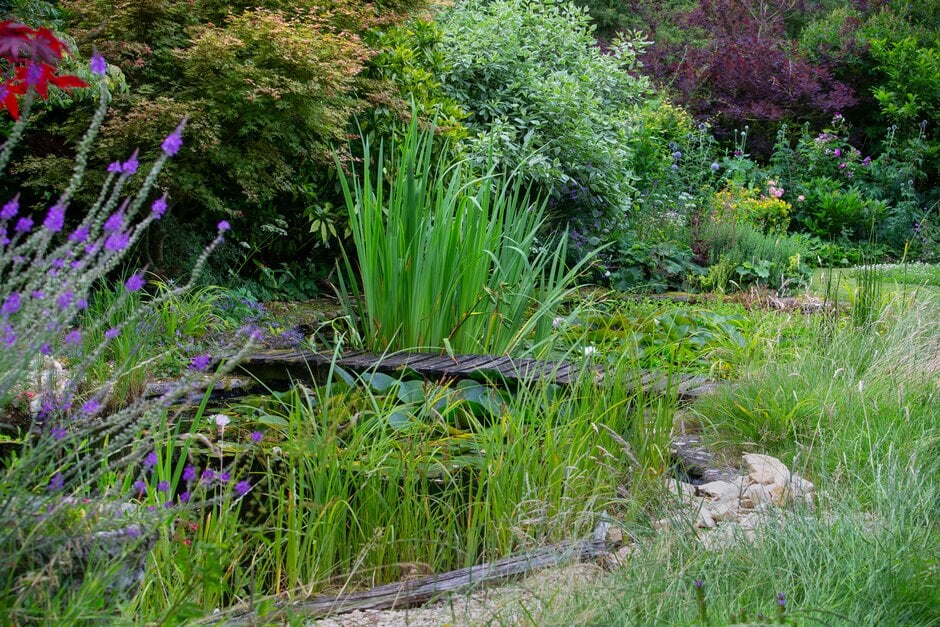 Plants and rocks can be used to create a border for your pond
Green roofs
A green roof, or living roof, is self-regenerating natural roofing system. Installing a green roof on a low-level roof or new extension can offer numerous environmental and aesthetic benefits.
Further guidance can be found in the Green Roof Code by the Green Roof Organisation (GRO).
| 11.5.10 | A planning application for a proposal incorporating a new green roof must include:- details of the green roof type, e.g.: sedum, biodiverse.
- 1:10 detail drawings of the green roof build-up.
- a plan of how the green roof will be maintained.
|
|
|
|
|
| 11.5.11 | Green roofs should be designed, installed and maintained in accordance with the recommendations of a specialist green roof company to ensure they are adequately maintained for the lifetime of the development.
|
|
| 11.5.12 | Before installing a green roof, it should be taken into consideration that all green roofs need to be accessible, to allow maintenance and replanting as/when required.
|
|
| 11.5.11 | Where green roofs are proposed they should be designed to: - ensure the roof can support the weight of any system.
- consider irrigation, if this is required based on planting selection.
- ensure waterproofing to prevent leaks.
- incorporate a drainage layer to manage excess water and prevent root damage.
- include plants for specific conditions of the roof (e.g., sun exposure, wind).
- incorporate a minimum of 100-200mm of soil to support a good mix of planting.
- include a mix of plant species to support local biodiversity.
- include regular maintenance.
|
|
11.6 Protected and building-dependent species
It is crucial that development in Waltham Forest does not negatively affect protected species such as bats, swifts, house martins and house sparrows.
Many of these species are building-dependent as they nest in pitched roofs, meaning wildlife access points must be considered when planning any home alteration or extension.
Swift bricks and soffit boxes are elements that can be integrated into the design of new or existing buildings to replace lost habitats for endangered bird species.
| 11.6.1 | Wildlife in the UK is protected under the Wildlife and Countryside Act (1981). Before undertaking home alteration works, it should be ensured that wildlife and protected species will not be negatively impacted.
|
|
| 11.6.2 | Any works that would affect breeding birds and their nests, such as works of demolition, vegetation removal or site clearance, should be done outside the nesting season from March to July.
|
|
Ecological surveys
| 11.6.3 | For any proposals where protected species or their habitats may be affected by development, an ecological survey must be carried out. This can include (but is not limited to) rear extensions, side extensions, the demolition of existing structures, and works to roofs or lofts.
|
|
| 11.6.4 | A mitigation strategy must be in place where recommended by the ecologist including timing of works to enable compliance with the Wildlife and Countryside Act 1981, retention of roost and nest sites where possible, and replacement with artificial integrated roost and nest sites such as soffit boxes where habitats are not retained.
|
|
Scaffolding requirements
| 11.6.5 | Scaffolding in London must not block active swift nests between May and August, as it is illegal to obstruct access under the Wildlife and Countryside Act 1981. Scaffolding must be designed to allow access, ideally keeping poles and boards at least 1.5m away from nest entrances to prevent trapping birds or starving young.
|
|
Swift bricks
A swift brick is a hollow, purpose‑made brick installed flush into an external wall with a small entrance hole, designed for small birds to be able to nest inside. A number of other red-listed bird species, such as house sparrows and house martins, also use swift bricks.
Soffit boxes
A soffit nesting box is a purpose‑built bird nesting chamber installed behind or within the soffit board of a building, designed to mimic cavities birds would naturally use. They’re especially useful in modern construction, where sealed eaves and tight insulation leave no natural gaps for birds.
| 11.6.6 | Residents should consider integrating swift bricks or soffit boxes where possible when planning an extension or home alteration.
|
|
| 11.6.7 | Swift bricks should be placed at least 5m or more above the ground.
|
|
| 11.6.8 | Where feasible, swift bricks are preferred over bird boxes as they are a permanent feature with low maintenance requirements.
|
|
Further information has been provided by the following organisations:
11.7 Sustainable drainage systems
Residential areas in the borough have experienced flooding from surface water during major storm events, and some areas are at greater risk than others. From draining hardstanding areas to replacing impervious surfaces, sustainable drainage systems can offer creative solutions for your garden.
Sustainable drainage systems not only help to alleviate local flood risk, but also help preserve the water quality of watercourses:
- Sustainable drainage systems slow the movement of surface water, helping to reduce pressure on street-level drainage systems.
- If street-level drainage is able to divert surplus runoff, combined sewer systems are less likely to require an emergency discharge of untreated water into watercourses.
- Systems typically deploy natural filtration, meaning that nutrients and pollutants harmful to the water environment are retained by plants and soils.
| 11.7.1 | Residents should consider integrating some of the following sustainable drainage features in their garden to help mitigate local flood risk.
|
|
| 11.7.2 | Sustainable drainage features should be integrated alongside planting, permeable surfaces and porous paving, while reducing areas of hardstanding.
|
|
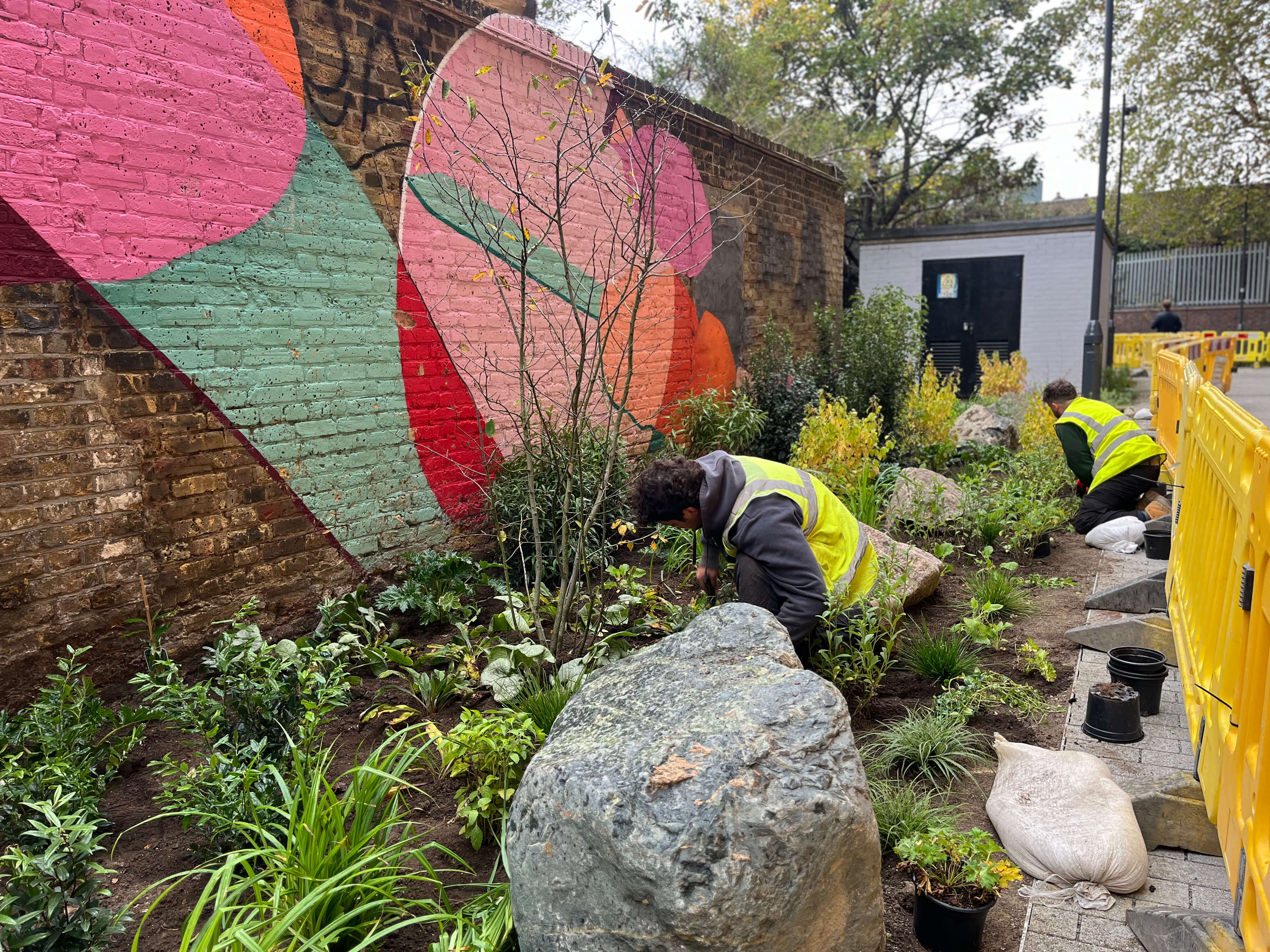 Raingarden in St. James Quarter, Walthamstow, helping to mitigate local flood risk
Soakaways
Soakaways are underground pits that collect rainwater runoff from roofs. Water is slowly released to the surrounding soil through percolation to prevent flooding and waterlogging.
Soakaways typically include underground plastic containers, which can hold large volumes of water. A geotextile membrane to stops soil from clogging the system.
Raingardens
Rain gardens are shallow, landscaped depressions that collect stormwater runoff from roofs, driveways, and lawns. Planting allows the water to soak into the ground instead of overwhelming storm drains.
Raingardens can be easily integrated into gardens of any size. Raingardens filter pollutants, recharge groundwater, reduce erosion and provide habitats for wildlife. For further guidance on creating your own raingarden, see advice from the Royal Horticultural Society here.
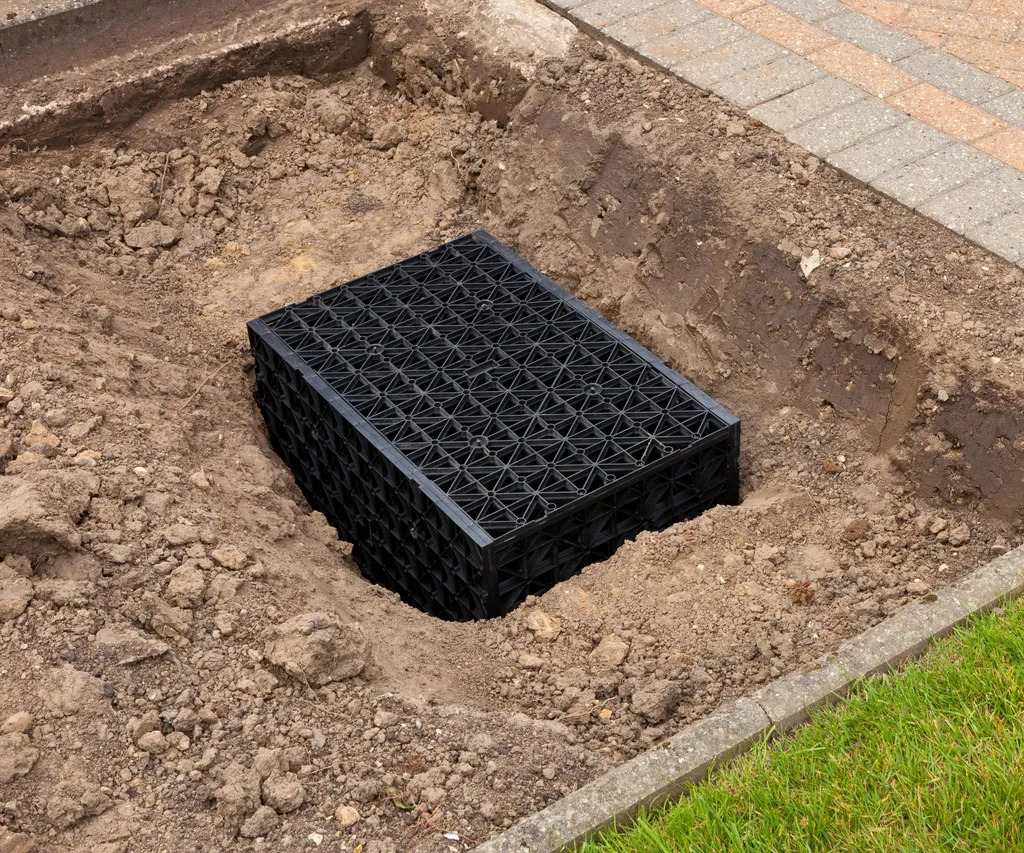 Soakaway being installed in a rear garden
Rainwater harvesting
Rainwater harvesting is where rainwater is collected from a roof via gutters and downpipes and stored in a water butt or tank. By capturing and storing water during downpours, rainwater systems help to reduce pressure on centralised drainage systems, while helping to conserve water.
Collected water can be used for watering your garden, topping up your pond, or providing cooling and refuge for wildlife during periods of prolonged dry weather.
| 11.6.9 | When incorporating rainwater harvesting, residents should consider: - the location of the water butt or tank so that it can collect the most rainwater (usually near a downpipe).
- fitting a filter or mesh in the downpipe.
- connecting a tap or hose to a storage tank for easier usage.
- adding overflows or a connection to a planted area, conveyance channel or drain as a last resort.
- draining the rainwater harvesting component prior to the onset of a forecast heavy rainfall event, ensure sufficient capacity is available.
|
|
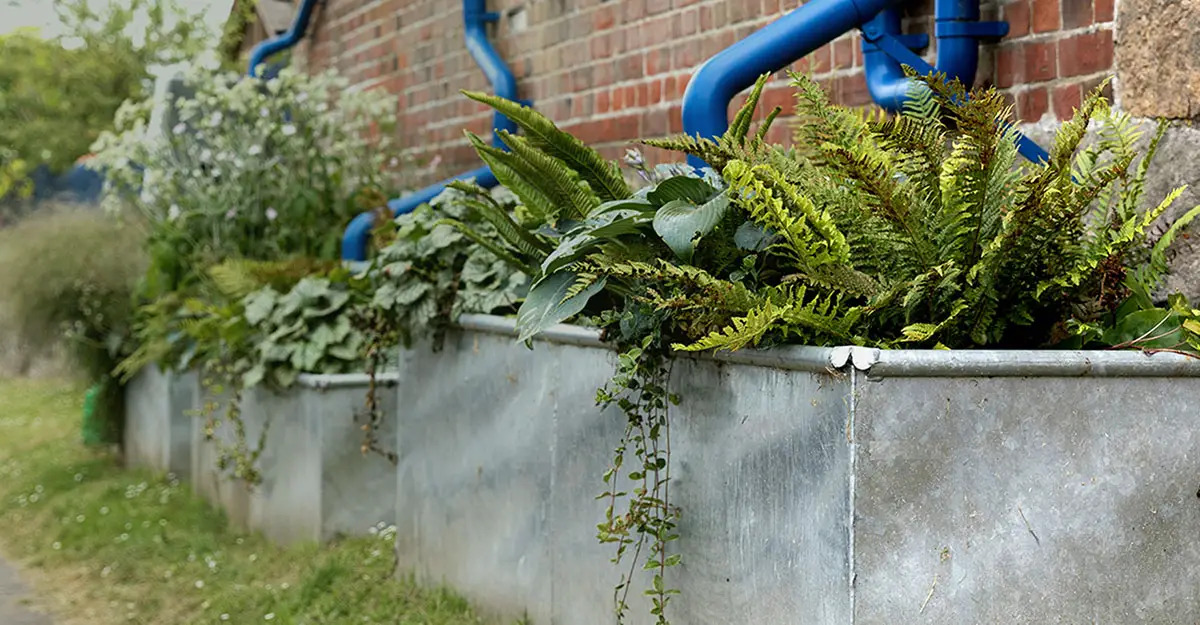 Downspouting in garden for plant watering
Other sustainable drainage features
Other ways to introduce sustainable drainage into your garden include:
- French drains, narrow channels filled with gravel, can help to reduce surface water flooding.
- Planters with inbuilt rainwater reservoirs can reduce the need for watering so frequently.
- Downpipes can be disconnected and water flow directed into planters, or to raingardens and soakaways, to reduce strain on sewers.
- Living and biodiverse roofs help to reduce surface water runoff, in addition to supporting biodiversity.
11.5 Habitats
You can create habitats in your garden by making a series of small changes, which may be planted or non-greening elements. Some easy ways to introduce habitats in your garden include:
- Installing bird feeders and nesting boxes affixed to trees in your garden can attract a variety of birds, which in turn helps to control insect populations.
- Work with neighbours to create a “hedgehog highway” at ground level by incorporating small gaps at the base of fences. Consider introducing mixed native hedgerows along property boundaries.
- Even a pile of logs in your garden can serve as a brilliant habitat for wildlife. A log pile left to decay can provide shelter, food, and breeding spots for insects, amphibians and small mammals.
Trees, hedges and planting
| 11.5.1 | Trees, hedges and planting, even if not regularly maintained, have biodiversity value. It is important to retain these elements where possible, in order to not disrupt existing wildlife.
|
|
| 11.5.2 | Residents are encouraged to create a wildflower meadow can help to support bees, butterflies, and other pollinators.
|
|
| 11.5.3 | Residents are encouraged to allow a portion of the garden to grow freely or to avoid mowing during Spring. Mowing less often or leaving a small area uncut helps to provide habitats for insects and food for pollinators.
|
|
| 11.5.4 | ‘No Mow May’ is a conservation campaign started by Plantlife, which urges gardeners to avoid mowing during May each year, helping to support garden biodiversity.
|
|
Sustainable hedgehog highway made from a recycled section of ceramic pipe
Ponds and waterways
A pond can be a great addition to a garden, creating a focal point and bringing wildlife and tranquillity to the space. Garden ponds can help to regulate the microclimate, create a thriving ecosystem for wildlife, reduce rainwater runoff and help to replenish local groundwater.
| 11.5.5 | When introducing a garden pond consider the following: - location within the garden.
- the shape and size.
- ensure a pond liner is used, or a pre-formed pond shell, to create a durable and functional pond. These could be made from recycled materials such as re-used compost bags.
- underlayment.
- pond pump and filter to ensure a healthy environment for animals and plants.
- water plants.
- gently sloping slides help wildlife.
- pond edging stones or materials. This can help animals to move in and out of the pond, helping to establish new habitats.
|
|
| 11.5.6 | It is important to make garden ponds safe if young children will be playing nearby. Consider installing a low-level fence, or creating a planted border around a pond.
|
|
| 11.5.7 | Regular maintenance is essential for maintaining a healthy garden pond. To reap the maximum benefits, gardeners should: - clean the pond regularly by removing debris and fallen leaves.
- trim and care for pond plants to prevent overgrowth.
|
|
| 11.5.8 | Where gardens are in proximity to rivers or watercourses, residents should consider naturalising these riverside areas, for example by removing hard materials and planting aquatic plant species, to encourage a diverse river environment to develop.
|
|
| 11.5.9 | Boundary treatments should be used to create, retain, and improve relevant buffer zones between built environments and rivers, seeking opportunities to remove any hardstanding and/or impermeable boundaries and improve aquatic habitats and biodiverse habitats connecting them.
|
|
Plants and rocks can be used to create a border for your pond
Green roofs
A green roof, or living roof, is self-regenerating natural roofing system. Installing a green roof on a low-level roof or new extension can offer numerous environmental and aesthetic benefits.
Further guidance can be found in the Green Roof Code by the Green Roof Organisation (GRO).
| 11.5.10 | A planning application for a proposal incorporating a new green roof must include:- details of the green roof type, e.g.: sedum, biodiverse.
- 1:10 detail drawings of the green roof build-up.
- a plan of how the green roof will be maintained.
|
|
|
|
|
| 11.5.11 | Green roofs should be designed, installed and maintained in accordance with the recommendations of a specialist green roof company to ensure they are adequately maintained for the lifetime of the development.
|
|
| 11.5.12 | Before installing a green roof, it should be taken into consideration that all green roofs need to be accessible, to allow maintenance and replanting as/when required.
|
|
| 11.5.11 | Where green roofs are proposed they should be designed to: - ensure the roof can support the weight of any system.
- consider irrigation, if this is required based on planting selection.
- ensure waterproofing to prevent leaks.
- incorporate a drainage layer to manage excess water and prevent root damage.
- include plants for specific conditions of the roof (e.g., sun exposure, wind).
- incorporate a minimum of 100-200mm of soil to support a good mix of planting.
- include a mix of plant species to support local biodiversity.
- include regular maintenance.
|
|
11.6 Protected and building-dependent species
It is crucial that development in Waltham Forest does not negatively affect protected species such as bats, swifts, house martins and house sparrows.
Many of these species are building-dependent as they nest in pitched roofs, meaning wildlife access points must be considered when planning any home alteration or extension.
Swift bricks and soffit boxes are elements that can be integrated into the design of new or existing buildings to replace lost habitats for endangered bird species.
| 11.6.1 | Wildlife in the UK is protected under the Wildlife and Countryside Act (1981). Before undertaking home alteration works, it should be ensured that wildlife and protected species will not be negatively impacted.
|
|
| 11.6.2 | Any works that would affect breeding birds and their nests, such as works of demolition, vegetation removal or site clearance, should be done outside the nesting season from March to July.
|
|
Ecological surveys
| 11.6.3 | For any proposals where protected species or their habitats may be affected by development, an ecological survey must be carried out. This can include (but is not limited to) rear extensions, side extensions, the demolition of existing structures, and works to roofs or lofts.
|
|
| 11.6.4 | A mitigation strategy must be in place where recommended by the ecologist including timing of works to enable compliance with the Wildlife and Countryside Act 1981, retention of roost and nest sites where possible, and replacement with artificial integrated roost and nest sites such as soffit boxes where habitats are not retained.
|
|
Scaffolding requirements
| 11.6.5 | Scaffolding in London must not block active swift nests between May and August, as it is illegal to obstruct access under the Wildlife and Countryside Act 1981. Scaffolding must be designed to allow access, ideally keeping poles and boards at least 1.5m away from nest entrances to prevent trapping birds or starving young.
|
|
Swift bricks
A swift brick is a hollow, purpose‑made brick installed flush into an external wall with a small entrance hole, designed for small birds to be able to nest inside. A number of other red-listed bird species, such as house sparrows and house martins, also use swift bricks.
Soffit boxes
A soffit nesting box is a purpose‑built bird nesting chamber installed behind or within the soffit board of a building, designed to mimic cavities birds would naturally use. They’re especially useful in modern construction, where sealed eaves and tight insulation leave no natural gaps for birds.
| 11.6.6 | Residents should consider integrating swift bricks or soffit boxes where possible when planning an extension or home alteration.
|
|
| 11.6.7 | Swift bricks should be placed at least 5m or more above the ground.
|
|
| 11.6.8 | Where feasible, swift bricks are preferred over bird boxes as they are a permanent feature with low maintenance requirements.
|
|
Further information has been provided by the following organisations:
11.7 Sustainable drainage systems
Residential areas in the borough have experienced flooding from surface water during major storm events, and some areas are at greater risk than others. From draining hardstanding areas to replacing impervious surfaces, sustainable drainage systems can offer creative solutions for your garden.
Sustainable drainage systems not only help to alleviate local flood risk, but also help preserve the water quality of watercourses:
- Sustainable drainage systems slow the movement of surface water, helping to reduce pressure on street-level drainage systems.
- If street-level drainage is able to divert surplus runoff, combined sewer systems are less likely to require an emergency discharge of untreated water into watercourses.
- Systems typically deploy natural filtration, meaning that nutrients and pollutants harmful to the water environment are retained by plants and soils.
| 11.7.1 | Residents should consider integrating some of the following sustainable drainage features in their garden to help mitigate local flood risk.
|
|
| 11.7.2 | Sustainable drainage features should be integrated alongside planting, permeable surfaces and porous paving, while reducing areas of hardstanding.
|
|
Raingarden in St. James Quarter, Walthamstow, helping to mitigate local flood riskSoakaways
Soakaways are underground pits that collect rainwater runoff from roofs. Water is slowly released to the surrounding soil through percolation to prevent flooding and waterlogging.
Soakaways typically include underground plastic containers, which can hold large volumes of water. A geotextile membrane to stops soil from clogging the system.
Raingardens
Rain gardens are shallow, landscaped depressions that collect stormwater runoff from roofs, driveways, and lawns. Planting allows the water to soak into the ground instead of overwhelming storm drains.
Raingardens can be easily integrated into gardens of any size. Raingardens filter pollutants, recharge groundwater, reduce erosion and provide habitats for wildlife. For further guidance on creating your own raingarden, see advice from the Royal Horticultural Society here.
Soakaway being installed in a rear garden
Rainwater harvesting
Rainwater harvesting is where rainwater is collected from a roof via gutters and downpipes and stored in a water butt or tank. By capturing and storing water during downpours, rainwater systems help to reduce pressure on centralised drainage systems, while helping to conserve water.
Collected water can be used for watering your garden, topping up your pond, or providing cooling and refuge for wildlife during periods of prolonged dry weather.
| 11.6.9 | When incorporating rainwater harvesting, residents should consider: - the location of the water butt or tank so that it can collect the most rainwater (usually near a downpipe).
- fitting a filter or mesh in the downpipe.
- connecting a tap or hose to a storage tank for easier usage.
- adding overflows or a connection to a planted area, conveyance channel or drain as a last resort.
- draining the rainwater harvesting component prior to the onset of a forecast heavy rainfall event, ensure sufficient capacity is available.
|
|
Downspouting in garden for plant watering
Other sustainable drainage features
Other ways to introduce sustainable drainage into your garden include:
- French drains, narrow channels filled with gravel, can help to reduce surface water flooding.
- Planters with inbuilt rainwater reservoirs can reduce the need for watering so frequently.
- Downpipes can be disconnected and water flow directed into planters, or to raingardens and soakaways, to reduce strain on sewers.
- Living and biodiverse roofs help to reduce surface water runoff, in addition to supporting biodiversity.