We use cookies to ensure our site functions properly and to store limited information about your usage. You may give or withdraw consent at any time. To find out more, read our privacy policy and cookie policy.
Manage Cookies
A cookie is information stored on your computer by a website you visit. Cookies often store your settings for a website, such as your preferred language or location. This allows the site to present you with information customized to fit your needs. As per the GDPR law, companies need to get your explicit approval to collect your data. Some of these cookies are ‘strictly necessary’ to provide the basic functions of the website and can not be turned off, while others if present, have the option of being turned off. Learn more about our Privacy and Cookie policies. These can be managed also from our cookie policy page.
Strictly necessary cookies(always on):
Necessary for enabling core functionality. The website cannot function properly without these cookies. This cannot be turned off. e.g. Sign in, Language
Analytics cookies:
Analytical cookies help us to analyse user behaviour, mainly to see if the users are able to find and act on things that they are looking for. They allow us to recognise and count the number of visitors and to see how visitors move around our website when they are using it. Tools used: Google Analytics
The advice in this document is intended to ensure the design and planning process for making home alterations is clear and leads to a positive outcome.
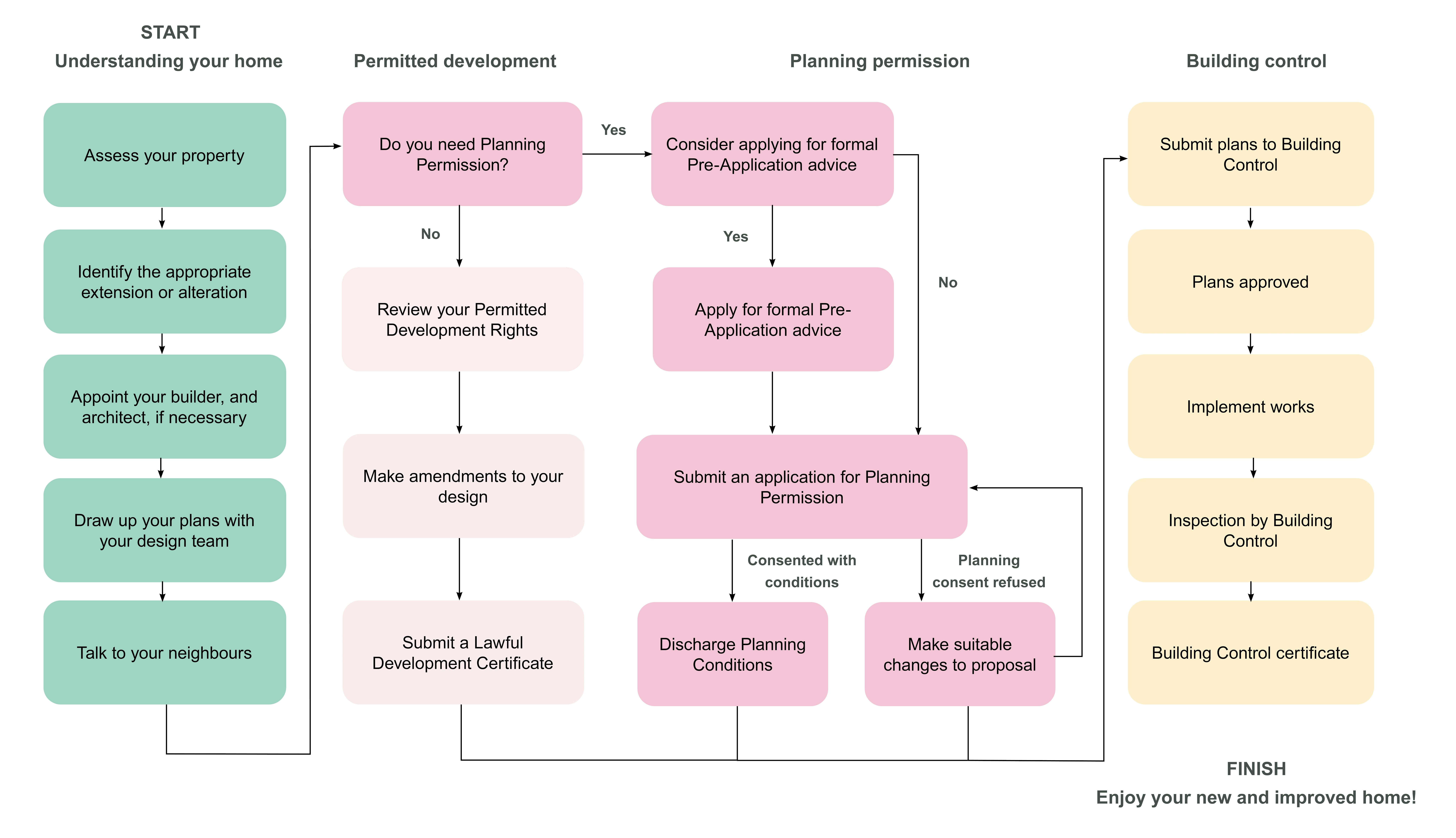
Certain home alterations require planning permission from the Council. View the flowchart in the right-hand to learn where planning permission is required and how to engage in the planning process.
For information about the guidance on this page should be interpreted and applied, visit Using this SPD.
6.2.1
Residents should assess the character of their home when considering building an extension or making an alteration. Many elements contribute to the character of a home, including:
housing type.
built form.
roofscape.
height.
materiality.
garden(s).
trees and biodiversity.
heritage.
6.2.2
Even where planning permission is not required, residents should still refer to this document to ensure exemplar design quality and an energy efficient home.
For inspiration, it may help to see the ‘Don’t Move, Improve!’ Awards, here.
6.2.5
If your house is terraced or semi-detached, the Party Wall Act may be relevant to your project. Read about this here.
6.3 Pre-application
6.3.1
Before submitting a planning application, applicants are advised to submit for pre-application advice to ensure all the planning requirements are being met.
6.3.2
At this stage applicants will receive guidance and advice about revisions to make to achieve planning permission, and confirmation of what drawings and documents should be submitted at planning stage.
6.3.3
There are two forms of pre-application advice available:
a formal pre-application service, where a form is submitted and written feedback is received.
a 20-minute online appointment, where the proposal is discussed with a planning officer.
What needs to be included in the planning application depends on the project. All the information itemised on the Validation Checklist must be submitted.
6.4.3
Planning applications are submitted via the Planning Portal. Once the planning application has been validated, the planning decision will be determined within 8 weeks. This involves the application being assessed and consulted on by planning officers.
6.4.4
Where a planning application is refused, there is a right of appeal against this decision. Further details about appeals can be found here.
6.4.5
Failure to obtain planning permission or building an extension differently to what has been approved can result in the Council undertaking enforcement action and the potential demolition of unapproved works.
6.4.6
Refer to the Interactive House on Planning Portal which has more guidance on complying with planning and building regulation requirements for common household projects.
6.5 Planning conditions
Planning conditions are additional measures attached to a planning permission which must be satisfied for development to proceed lawfully. They seek to mitigate adverse impacts and improve the quality of development.
See here for further guidance on planning conditions at Waltham Forest.
6.5.1
When planning permission has been granted, works must comply with any planning conditions attached to the approval and must be carried out within the specified time period.
6.5.2
Applications will be subject to standard conditions, such as a requirement to build the development in accordance with the approved plans, for the materials to match the proposed materials and that the development must commence within three years.
6.6 Permitted development rights
Some types of small extensions and minor alterations are covered by what is called permitted development rights. For proposals that fall within permitted development rights, it is not necessary to apply for planning permission.
For details of permitted development rights for common home alterations and extensions, refer to this page on the Planning Portal.
6.6.2
For some projects carried out under permitted development, prior approval may be required. For further information on prior approval refer to this page on the Planning Portal.
6.6.3
It should be noted that converted houses, flats, maisonettes and listed buildings do not always have the same permitted development rights, and planning permission may still be required for minor alterations. For details of permitted development rights for flats and maisonettes, refer to this page on the Planning Portal.
6.6.4
For homes within a Conservation Area there may be an Article 4 direction on the property, removing permitted development rights. Read more about this here.
6.7 Lawful Development Certificate
6.7.1
For proposals that meet permitted development guidelines or have been granted Prior Approval, a Lawful Development Certificate should be obtained. This will provide proof that the proposed building work is lawful. The Planning Portal contains information on how to apply for a Lawful Development Certificate.
6.7.2
Obtaining an Lawful Development Certificate is especially important for homeowners who might want to sell their property in the future.
6.8 Building regulations
6.8.1
Building regulations approval is different from planning permission. For any extension or alteration to built fabric, building regulation approval is required. See here for more information about building regulations approval.
6.8.2
Building regulations approval is required for projects such as a new building, adding a loft, converting a house to flats, or removing all or part of a wall. It is not required for repairs, minor maintenance, or remodelling an existing bathroom with only minor plumbing changes.
6.9 Building control
6.9.1
Read about the Waltham Forest Building Control Service here. Alternatively, other registered building control approvers can be used.
6.10 Article 4 directions
6.10.1
An area may be subject to an Article 4 direction, meaning permitted development rights are restricted within this specified area. Check here to see which parts of Waltham Forest this affects.
6.10.2
The purpose of some Article 4 directions is to retain high quality architectural features and ensure that any changes consider their surroundings.
6.10.3
Though Article 4 directions remove permitted development rights, some changes may still be made without full planning permission.
6.10.4
Article 4 directions are in place across some conservation areas in Waltham Forest. Read more about planning permission and permitted development in conservation areas here.
6.2 Planning process flowchart
The advice in this document is intended to ensure the design and planning process for making home alterations is clear and leads to a positive outcome.
Certain home alterations require planning permission from the Council. View the flowchart in the right-hand to learn where planning permission is required and how to engage in the planning process.
For information about the guidance on this page should be interpreted and applied, visit Using this SPD.
6.2.1
Residents should assess the character of their home when considering building an extension or making an alteration. Many elements contribute to the character of a home, including:
housing type.
built form.
roofscape.
height.
materiality.
garden(s).
trees and biodiversity.
heritage.
6.2.2
Even where planning permission is not required, residents should still refer to this document to ensure exemplar design quality and an energy efficient home.
For inspiration, it may help to see the ‘Don’t Move, Improve!’ Awards, here.
6.2.5
If your house is terraced or semi-detached, the Party Wall Act may be relevant to your project. Read about this here.
6.3 Pre-application
6.3.1
Before submitting a planning application, applicants are advised to submit for pre-application advice to ensure all the planning requirements are being met.
6.3.2
At this stage applicants will receive guidance and advice about revisions to make to achieve planning permission, and confirmation of what drawings and documents should be submitted at planning stage.
6.3.3
There are two forms of pre-application advice available:
a formal pre-application service, where a form is submitted and written feedback is received.
a 20-minute online appointment, where the proposal is discussed with a planning officer.
What needs to be included in the planning application depends on the project. All the information itemised on the Validation Checklist must be submitted.
6.4.3
Planning applications are submitted via the Planning Portal. Once the planning application has been validated, the planning decision will be determined within 8 weeks. This involves the application being assessed and consulted on by planning officers.
6.4.4
Where a planning application is refused, there is a right of appeal against this decision. Further details about appeals can be found here.
6.4.5
Failure to obtain planning permission or building an extension differently to what has been approved can result in the Council undertaking enforcement action and the potential demolition of unapproved works.
6.4.6
Refer to the Interactive House on Planning Portal which has more guidance on complying with planning and building regulation requirements for common household projects.
6.5 Planning conditions
Planning conditions are additional measures attached to a planning permission which must be satisfied for development to proceed lawfully. They seek to mitigate adverse impacts and improve the quality of development.
See here for further guidance on planning conditions at Waltham Forest.
6.5.1
When planning permission has been granted, works must comply with any planning conditions attached to the approval and must be carried out within the specified time period.
6.5.2
Applications will be subject to standard conditions, such as a requirement to build the development in accordance with the approved plans, for the materials to match the proposed materials and that the development must commence within three years.
6.6 Permitted development rights
Some types of small extensions and minor alterations are covered by what is called permitted development rights. For proposals that fall within permitted development rights, it is not necessary to apply for planning permission.
For details of permitted development rights for common home alterations and extensions, refer to this page on the Planning Portal.
6.6.2
For some projects carried out under permitted development, prior approval may be required. For further information on prior approval refer to this page on the Planning Portal.
6.6.3
It should be noted that converted houses, flats, maisonettes and listed buildings do not always have the same permitted development rights, and planning permission may still be required for minor alterations. For details of permitted development rights for flats and maisonettes, refer to this page on the Planning Portal.
6.6.4
For homes within a Conservation Area there may be an Article 4 direction on the property, removing permitted development rights. Read more about this here.
6.7 Lawful Development Certificate
6.7.1
For proposals that meet permitted development guidelines or have been granted Prior Approval, a Lawful Development Certificate should be obtained. This will provide proof that the proposed building work is lawful. The Planning Portal contains information on how to apply for a Lawful Development Certificate.
6.7.2
Obtaining an Lawful Development Certificate is especially important for homeowners who might want to sell their property in the future.
6.8 Building regulations
6.8.1
Building regulations approval is different from planning permission. For any extension or alteration to built fabric, building regulation approval is required. See here for more information about building regulations approval.
6.8.2
Building regulations approval is required for projects such as a new building, adding a loft, converting a house to flats, or removing all or part of a wall. It is not required for repairs, minor maintenance, or remodelling an existing bathroom with only minor plumbing changes.
6.9 Building control
6.9.1
Read about the Waltham Forest Building Control Service here. Alternatively, other registered building control approvers can be used.
6.10 Article 4 directions
6.10.1
An area may be subject to an Article 4 direction, meaning permitted development rights are restricted within this specified area. Check here to see which parts of Waltham Forest this affects.
6.10.2
The purpose of some Article 4 directions is to retain high quality architectural features and ensure that any changes consider their surroundings.
6.10.3
Though Article 4 directions remove permitted development rights, some changes may still be made without full planning permission.
6.10.4
Article 4 directions are in place across some conservation areas in Waltham Forest. Read more about planning permission and permitted development in conservation areas here.