9.4 Heating and cooling
Home alteration or extension projects pose an opportunity to improve the comfort of living spaces, and the installation of one or more of the following systems should be considered:
- An air source heat pump (ASHP).
- A mechanical ventilation with heat recovery (MVHR) system.
- A wet or dry underfloor heating system.
| 9.4.1 | Wood burning fires and stoves significantly contribute to indoor and outdoor air pollution and are discouraged within the borough. The fine particulate matter they release into the air reduces air quality and is harmful to human health, being linked to a number of respiratory diseases.
|
|
| 9.4.2 | Homeowners with wood burning fireplaces should consider switching to one of the healthier and more sustainable heating systems described below.
|
|
|
|
|
| 9.4.3 | For residents undertaking a home extension or alteration, proposals including wood burning fires or stoves will not be approved and alternative, healthier and more sustainable heating systems must be considered.
|
|
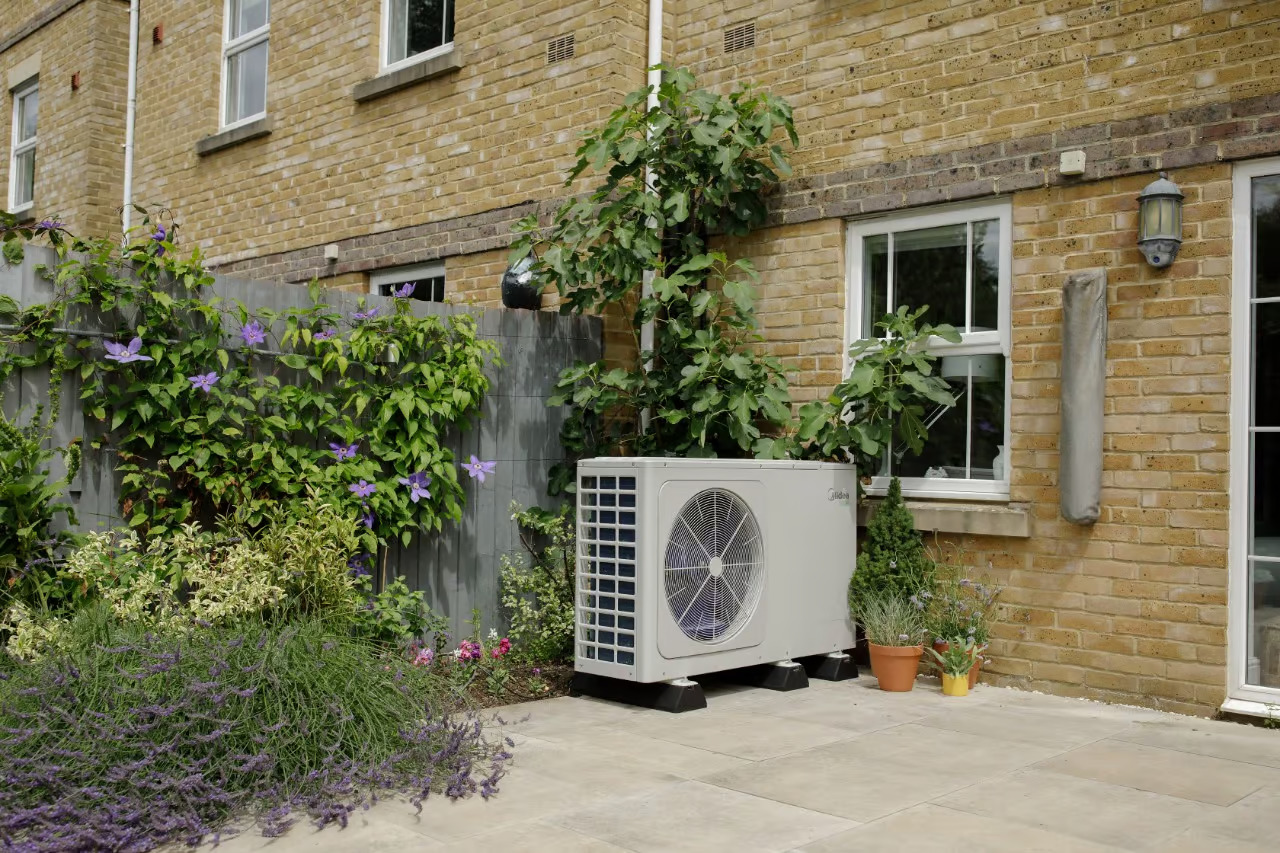 This air source heat pump is located in a rear garden, as close to the home as possible, to improve efficiency
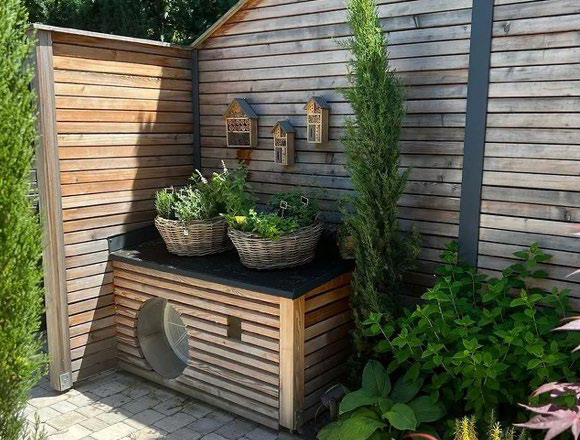 Heat pump within an enclosure, with the condenser fan exposed to increase airflow, resulting in improved efficiency
Air source heat pumps (ASHP)
An air source heat pump is a type of heat pump that can now be installed in most homes to serve as a more energy efficient alternative to a gas boiler. It works by transferring heat energy from the outside air to the water in a heating system, using a small amount of energy.
Some extensions or alterations may require moving or replacing an existing gas boiler, in which case residents are encouraged to consider installing an air source heat pump instead. It is encouraged that a boiler near the end of its life is replaced with an air source heat pump, rather than a new boiler.
Maximising efficiency
Modern day boilers can be 20% more efficient than older boilers. However, air source heat pumps are approximately three times more efficient than gas boilers.
Some of the electricity used to run the heat pump can be provided from renewable energy, such as through solar panels on the roof. This can reduce carbon emissions from heating and cooling by 80-90%.
Types of air source heat pumps
- A monobloc system has all the components in a single outdoor unit. Pipes carry water to the central heating system and a hot water cylinder inside your home. Monobloc systems tend to be more common because they’re cheaper, quick to install and take up less space in your home.
- A split system separates the heat pump into indoor and outdoor units. However, split systems can be more efficient because some of the heat transfer takes place inside the building where it’s warmer, resulting in less heat being lost.
Heat storage
- Some hybrid systems have a heat pump providing heating and a boiler providing hot water on demand. However, a standard air source heat pump doesn’t provide hot water on demand like a combi boiler, meaning you may need to install a hot water cylinder to store the heated water.
- Hot water cylinders can usually fit inside a cupboard measuring 80cm x 80cm. Alternatively, a heat battery can be used, which takes up less space than a hot water cylinder.
| 9.4.4 | It is encouraged that loft insulation, window and ventilation improvements are carried out prior to the installation of an air source heat pump, to first reduce space heating demand.
|
|
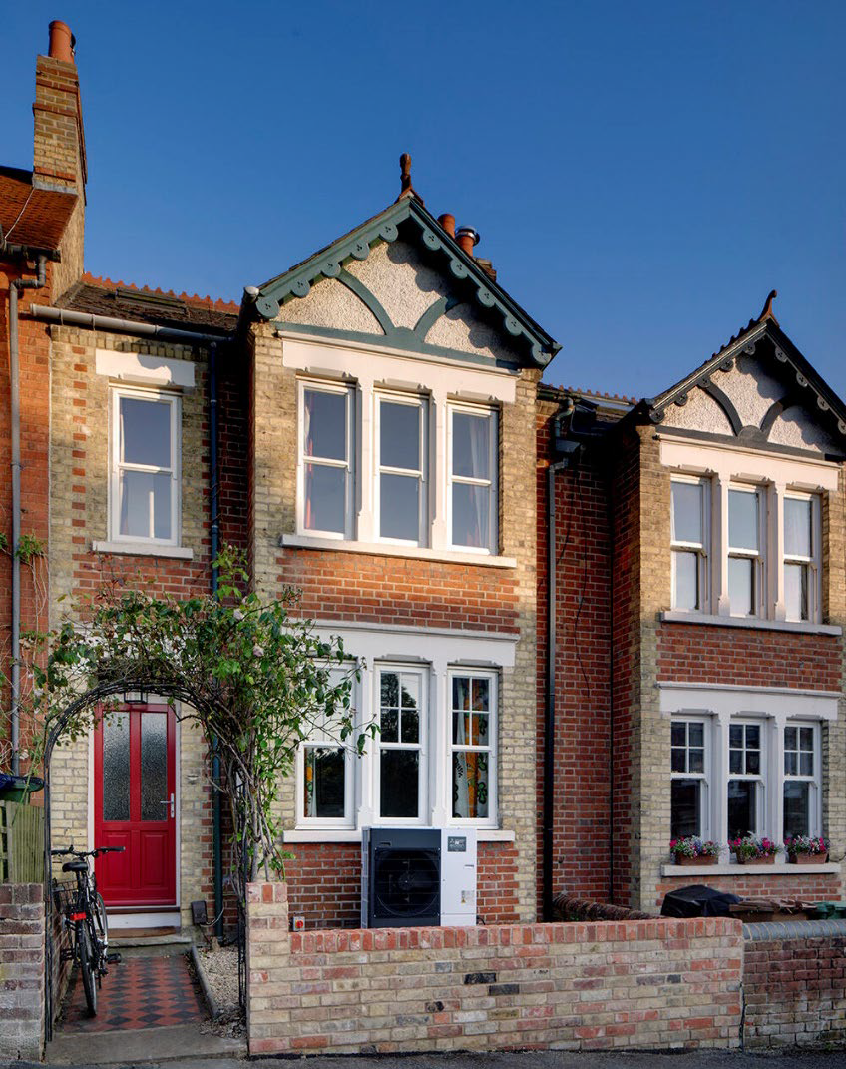 Heat pumps may be located in front gardens, though this should only be when there is insufficient space in the rear garden
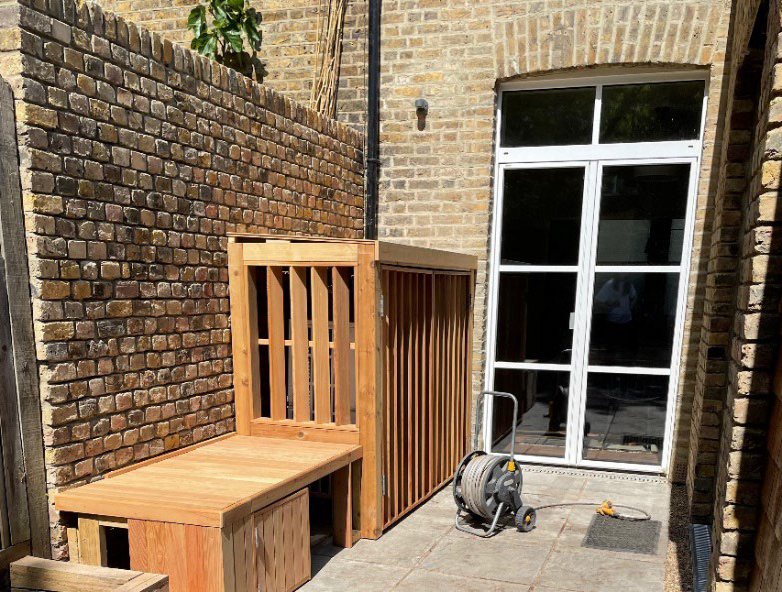 Heat pump within an enclosure, with openings to maximise airflow around the condensing unit
Planning permission
| 9.4.5 | Air source heat pumps can often be installed without the need for planning permission. For details of permitted development rights for air source heat pumps, refer to this page on the Planning Portal. If the proposal does not fulfil the criteria stated here, planning permission will be required.
|
|
| 9.4.6 | To qualify as permitted development, an air source heat pump must not exceed a noise level of 37 dB(A) at the nearest habitable room of a neighbouring property. |
|
| 9.4.7 | In some cases, an enclosure may be required to mitigate noise. Even where a heat pump compressor can be installed under permitted development, planning permission may be required for its enclosure.
|
|
| 9.4.8 | Different rules apply for the installation of an air source heat pump in a conservation area. For example, planning permission is always required for the installation of a heat pump in a front garden. |
|
| 9.4.9 | For the installation of air source heat pump within the curtilage of a listed building, planning permission and listed building consent will be required.
|
|
|
|
|
| 9.4.10 | Pre-application submission is encouraged for all proposals for air source heat pumps where planning permission is required. |
|
| 9.4.11 | For air source heat pumps that require planning permission, applications must include: - plan drawing clearly indicating the location and dimensions of the proposed heat pump.
- drawings clearly showing the dimensions and design of the enclosure, if applicable. This should include proposed materials and opening mechanisms.
- a Noise Impact Assessment, showing clearly the level of noise produced by the air source heat pump, calculated using the Microgeneration Certification Scheme (MCS) planning standard (MCS 020).
|
|
| 9.4.12 | Applicants should refer to the local validation checklist for up-to-date information on planning requirements.
|
|
Location
| 9.4.13 | In Waltham Forest, air source heat pumps must be placed within rear gardens wherever possible. Heat pumps must only be placed in front gardens where there is insufficient space or no access to the rear garden.
|
|
| 9.4.14 | Noise impact must be considered when deciding where to place an air source heat pump.
|
|
|
|
|
| 9.4.15 | Where an air source heat pump is proposed to the front of a property, or areas visible from public vantage points, a screen or planting is encouraged to minimise its visual impact. This is particularly important in conservation areas. For air source heat pump installed on a roof, planning permission is not normally required, as long as it is:- not to be on a pitched roof.
- not to be within 1m of the curtilage of the property, if installed on a flat roof.
|
|
| 9.4.16 | The location of an air source heat pump should be carefully coordinated with:- the existing house.
- any proposed extensions.
- any surrounding trees and planting. Air source heat pumps release cool air, which can damage some plants.
|
|
| 9.4.17 | Air source heat pumps should be placed as close to the home as possible, as this reduces the required amount of pipework, increasing efficiency.
|
|
Further guidance
This guide from Historic England provides specific advice on installing air source heat pumps in older buildings.
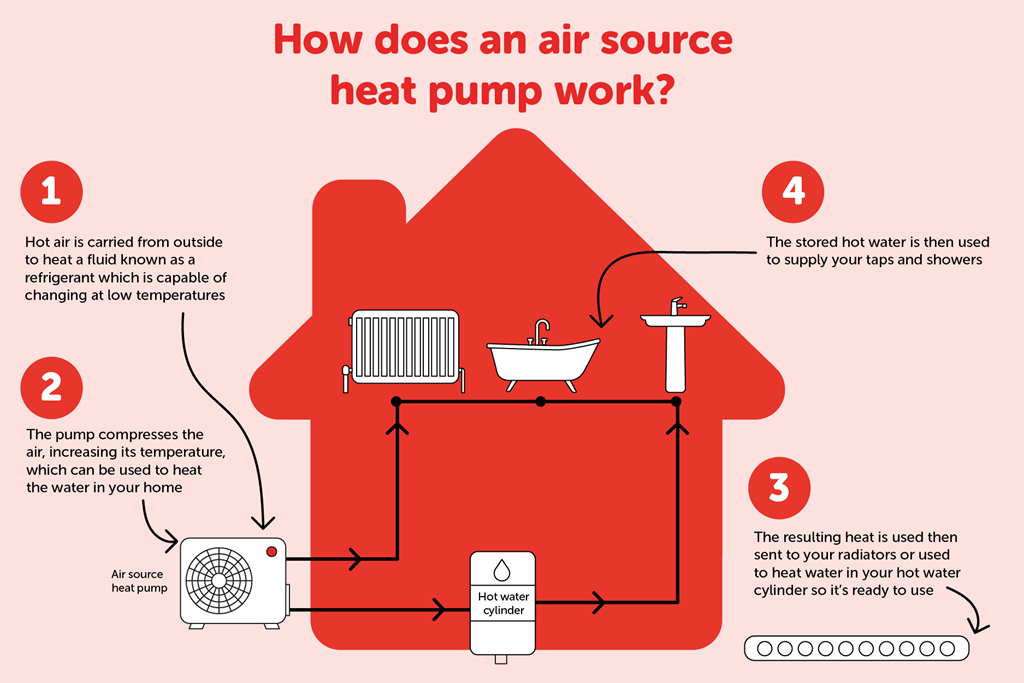 Air source heat pumps serve as a more efficient alternative to gas boilers
Mechanical ventilation with heat recovery (MVHR)
Having adequate ventilation in your home is essential for your health: ventilation removes stale, damp air and replaces it with fresh air, helping to improve indoor air quality.
- Many people ventilate their home by opening windows and doors (known as ‘natural’ or ‘passive’ ventilation). However, in winter this can lead to excessive loss of heat.
- Extractor fans can make an improvement to ventilation in kitchens and bathrooms. However, as they are used intermittently they usually are not left on long enough to regulate the indoor air quality.
- Modern homes are typically more airtight than older buildings, meaning they are likely to have fewer draughts. Due to this, modern homes may be fitted with mechanical ventilation with heat recovery systems.
Mechanical ventilation with heat recovery systems use heat exchangers to ensure heat isn’t lost due to air flowing through your home. A well-designed system provides clean, fresh air, reduces heat loss and improves energy efficiency. Systems typically have between 80-90% heat recovery efficiency. This means that a heat recovery system could reduce your heating costs by 25%, while ensuring a healthy, well-ventilated home.
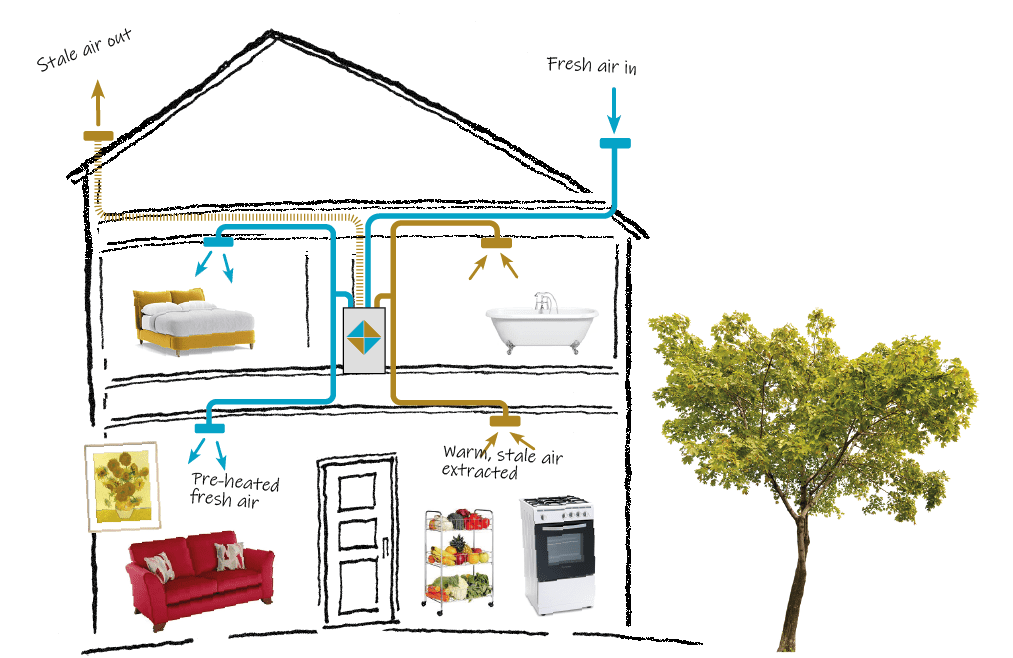 Illustration showing how mechanical ventilation with heat recovery works in a home
| 9.4.18 | Planning permission is not normally required for installing a mechanical ventilation with heat recovery system. It is usually considered permitted development for a house or flat, as long as the property is not a listed building or within a conservation area.
|
|
|
|
|
| 9.4.19 | It is encouraged that a mechanical ventilation with heat recovery system is considered over air conditioning. Mechanical ventilation with heat recovery serves as a more energy efficient alternative, providing better indoor air quality and humidity control.
|
|
| 9.4.20 | Unlike air conditioning systems, mechanical ventilation with heat recovery systems are typically inaudible during normal use.
|
|
| 9.4.21 | Mechanical ventilation with heat recovery works best in buildings that are relatively airtight, so as a retrofit measure it is best suited to properties that are being fully refurbished.
|
|
| 9.4.22 | Retrofitting mechanical ventilation with heat recovery in an existing property needs to follow a comprehensive airtightness strategy, including a series of airtightness tests.
|
|
How does MVHR work?
- Mechanical ventilation with heat recovery systems extract warm, damp air from the home and draw in fresh air from the outside. The warm, extracted air is passed through a heat exchanger to recover the heat before being expelled outside.
- Cool, fresh outside air is also passed through the heat exchanger, where it is pre-warmed before being pumped into the property.
- These systems tend to be made up of concealed ducting (piping) in ceiling cavities that lead to a heat exchanger unit in a cupboard, utility room or loft.
- Some units have a boost setting which can be used during activities that generate excessive moisture, such cooking or showering.
Summer bypass
- Mechanical ventilation with heat recovery has an operational system called “summer bypass” that can be used in warmer weather. This is automatically activated when the indoor temperature is warmer than the outdoor temperature.
- An internal damper diverts the extracted warm air around the heat exchanger directly outside. This ensures that the cooler incoming air is not pre-heated, helping to cool the home passively.
Air filtration
- Air filtration is commonly built into mechanical ventilation with heat recovery systems to prevent pollutant particles from entering the home, improving air quality.
- This includes filtering out pollen, providing a more comfortable indoor environment for hayfever sufferers.
Underfloor Heating
Underfloor heating provides both convective heat and radiated heat, creating a consistent temperature from floor to ceiling. Unlike radiators, which heat the air in your home by convection, underfloor heating distributes heat evenly across a room.
Underfloor heating systems are suitable for installation in most homes. Underfloor heating typically means that central heating can run at a lower temperature, saving you money over time.
Running costs vary based on the fuel used to heat the system, but can be reduced by the generation of renewable energy.
| 9.4.23 | Planning permission is not normally required for installing underfloor heating. It is usually considered permitted development for a house or flat, as long as the property is not a listed building. |
|
|
|
|
| 9.4.24 | Underfloor heating takes longer to heat up and cool down than radiators, due to how flooring materials store and release heat. For this reason, it is best suited to properties where people will be at home for most of the day. |
|
| 9.4.25 | For the system to provide adequate heat and be cost-effective, it is critical that the property is well insulated and draught-proofed. This will minimise heat loss and reduce the warming up time. |
|
| 9.4.26 | It should be noted that installing underfloor heating is disruptive, and should only be carried out if significant building work is already being undertaken. |
|
| 9.4.27 | Air source heat pumps are particularly effective when used with wet underfloor heating, as air source heat pumps heat water to a temperature close to the temperature required for underfloor heating. |
|
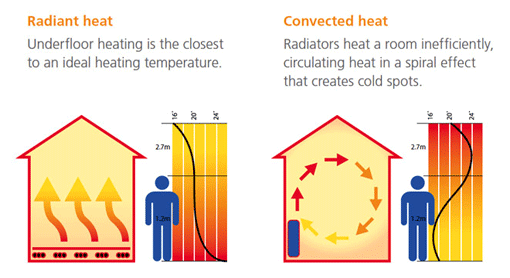 Diagrams illustrating how underfloor heating distributes heat within a room, when compared to radiators
Underfloor heating systems come in two types, wet and dry systems:
Wet systems
- Wet systems can be run using a conventional gas, oil or solid fuel boiler, or especially efficiently by a heat pump.
- They work by circulating heated water through piping. A central control unit means that rooms are heated to a certain temperature, when the heating system turns off.
Dry systems
- Dry underfloor heating uses wires that are heated up using electricity. The system can come as ready-made mats or loose wires that need to be fitted.
- Dry underfloor heating should be connected to individual room thermostats so the temperature of each room can be controlled.
Which system is right for me?
- Dry systems are easier to install in existing homes than wet systems, and can be fitted in narrower floor depths.
- Dry systems can also be more responsive than wet systems, meaning rooms heat up more quickly.
- Installation costs vary significantly, based on the system used, and the number of rooms that will be heated.
- Typically, the cost of installing a wet system will be higher than installing a dry system.
9.4 Heating and cooling
Home alteration or extension projects pose an opportunity to improve the comfort of living spaces, and the installation of one or more of the following systems should be considered:
- An air source heat pump (ASHP).
- A mechanical ventilation with heat recovery (MVHR) system.
- A wet or dry underfloor heating system.
| 9.4.1 | Wood burning fires and stoves significantly contribute to indoor and outdoor air pollution and are discouraged within the borough. The fine particulate matter they release into the air reduces air quality and is harmful to human health, being linked to a number of respiratory diseases.
|
|
| 9.4.2 | Homeowners with wood burning fireplaces should consider switching to one of the healthier and more sustainable heating systems described below.
|
|
|
|
|
| 9.4.3 | For residents undertaking a home extension or alteration, proposals including wood burning fires or stoves will not be approved and alternative, healthier and more sustainable heating systems must be considered.
|
|
This air source heat pump is located in a rear garden, as close to the home as possible, to improve efficiency
Heat pump within an enclosure, with the condenser fan exposed to increase airflow, resulting in improved efficiency
Air source heat pumps (ASHP)
An air source heat pump is a type of heat pump that can now be installed in most homes to serve as a more energy efficient alternative to a gas boiler. It works by transferring heat energy from the outside air to the water in a heating system, using a small amount of energy.
Some extensions or alterations may require moving or replacing an existing gas boiler, in which case residents are encouraged to consider installing an air source heat pump instead. It is encouraged that a boiler near the end of its life is replaced with an air source heat pump, rather than a new boiler.
Maximising efficiency
Modern day boilers can be 20% more efficient than older boilers. However, air source heat pumps are approximately three times more efficient than gas boilers.
Some of the electricity used to run the heat pump can be provided from renewable energy, such as through solar panels on the roof. This can reduce carbon emissions from heating and cooling by 80-90%.
Types of air source heat pumps
- A monobloc system has all the components in a single outdoor unit. Pipes carry water to the central heating system and a hot water cylinder inside your home. Monobloc systems tend to be more common because they’re cheaper, quick to install and take up less space in your home.
- A split system separates the heat pump into indoor and outdoor units. However, split systems can be more efficient because some of the heat transfer takes place inside the building where it’s warmer, resulting in less heat being lost.
Heat storage
- Some hybrid systems have a heat pump providing heating and a boiler providing hot water on demand. However, a standard air source heat pump doesn’t provide hot water on demand like a combi boiler, meaning you may need to install a hot water cylinder to store the heated water.
- Hot water cylinders can usually fit inside a cupboard measuring 80cm x 80cm. Alternatively, a heat battery can be used, which takes up less space than a hot water cylinder.
| 9.4.4 | It is encouraged that loft insulation, window and ventilation improvements are carried out prior to the installation of an air source heat pump, to first reduce space heating demand.
|
|
Heat pumps may be located in front gardens, though this should only be when there is insufficient space in the rear garden
Heat pump within an enclosure, with openings to maximise airflow around the condensing unit
Planning permission
| 9.4.5 | Air source heat pumps can often be installed without the need for planning permission. For details of permitted development rights for air source heat pumps, refer to this page on the Planning Portal. If the proposal does not fulfil the criteria stated here, planning permission will be required.
|
|
| 9.4.6 | To qualify as permitted development, an air source heat pump must not exceed a noise level of 37 dB(A) at the nearest habitable room of a neighbouring property. |
|
| 9.4.7 | In some cases, an enclosure may be required to mitigate noise. Even where a heat pump compressor can be installed under permitted development, planning permission may be required for its enclosure.
|
|
| 9.4.8 | Different rules apply for the installation of an air source heat pump in a conservation area. For example, planning permission is always required for the installation of a heat pump in a front garden. |
|
| 9.4.9 | For the installation of air source heat pump within the curtilage of a listed building, planning permission and listed building consent will be required.
|
|
|
|
|
| 9.4.10 | Pre-application submission is encouraged for all proposals for air source heat pumps where planning permission is required. |
|
| 9.4.11 | For air source heat pumps that require planning permission, applications must include: - plan drawing clearly indicating the location and dimensions of the proposed heat pump.
- drawings clearly showing the dimensions and design of the enclosure, if applicable. This should include proposed materials and opening mechanisms.
- a Noise Impact Assessment, showing clearly the level of noise produced by the air source heat pump, calculated using the Microgeneration Certification Scheme (MCS) planning standard (MCS 020).
|
|
| 9.4.12 | Applicants should refer to the local validation checklist for up-to-date information on planning requirements.
|
|
Location
| 9.4.13 | In Waltham Forest, air source heat pumps must be placed within rear gardens wherever possible. Heat pumps must only be placed in front gardens where there is insufficient space or no access to the rear garden.
|
|
| 9.4.14 | Noise impact must be considered when deciding where to place an air source heat pump.
|
|
|
|
|
| 9.4.15 | Where an air source heat pump is proposed to the front of a property, or areas visible from public vantage points, a screen or planting is encouraged to minimise its visual impact. This is particularly important in conservation areas. For air source heat pump installed on a roof, planning permission is not normally required, as long as it is:- not to be on a pitched roof.
- not to be within 1m of the curtilage of the property, if installed on a flat roof.
|
|
| 9.4.16 | The location of an air source heat pump should be carefully coordinated with:- the existing house.
- any proposed extensions.
- any surrounding trees and planting. Air source heat pumps release cool air, which can damage some plants.
|
|
| 9.4.17 | Air source heat pumps should be placed as close to the home as possible, as this reduces the required amount of pipework, increasing efficiency.
|
|
Further guidance
This guide from Historic England provides specific advice on installing air source heat pumps in older buildings.
Air source heat pumps serve as a more efficient alternative to gas boilers
Mechanical ventilation with heat recovery (MVHR)
Having adequate ventilation in your home is essential for your health: ventilation removes stale, damp air and replaces it with fresh air, helping to improve indoor air quality.
- Many people ventilate their home by opening windows and doors (known as ‘natural’ or ‘passive’ ventilation). However, in winter this can lead to excessive loss of heat.
- Extractor fans can make an improvement to ventilation in kitchens and bathrooms. However, as they are used intermittently they usually are not left on long enough to regulate the indoor air quality.
- Modern homes are typically more airtight than older buildings, meaning they are likely to have fewer draughts. Due to this, modern homes may be fitted with mechanical ventilation with heat recovery systems.
Mechanical ventilation with heat recovery systems use heat exchangers to ensure heat isn’t lost due to air flowing through your home. A well-designed system provides clean, fresh air, reduces heat loss and improves energy efficiency. Systems typically have between 80-90% heat recovery efficiency. This means that a heat recovery system could reduce your heating costs by 25%, while ensuring a healthy, well-ventilated home.
Illustration showing how mechanical ventilation with heat recovery works in a home
| 9.4.18 | Planning permission is not normally required for installing a mechanical ventilation with heat recovery system. It is usually considered permitted development for a house or flat, as long as the property is not a listed building or within a conservation area.
|
|
|
|
|
| 9.4.19 | It is encouraged that a mechanical ventilation with heat recovery system is considered over air conditioning. Mechanical ventilation with heat recovery serves as a more energy efficient alternative, providing better indoor air quality and humidity control.
|
|
| 9.4.20 | Unlike air conditioning systems, mechanical ventilation with heat recovery systems are typically inaudible during normal use.
|
|
| 9.4.21 | Mechanical ventilation with heat recovery works best in buildings that are relatively airtight, so as a retrofit measure it is best suited to properties that are being fully refurbished.
|
|
| 9.4.22 | Retrofitting mechanical ventilation with heat recovery in an existing property needs to follow a comprehensive airtightness strategy, including a series of airtightness tests.
|
|
How does MVHR work?
- Mechanical ventilation with heat recovery systems extract warm, damp air from the home and draw in fresh air from the outside. The warm, extracted air is passed through a heat exchanger to recover the heat before being expelled outside.
- Cool, fresh outside air is also passed through the heat exchanger, where it is pre-warmed before being pumped into the property.
- These systems tend to be made up of concealed ducting (piping) in ceiling cavities that lead to a heat exchanger unit in a cupboard, utility room or loft.
- Some units have a boost setting which can be used during activities that generate excessive moisture, such cooking or showering.
Summer bypass
- Mechanical ventilation with heat recovery has an operational system called “summer bypass” that can be used in warmer weather. This is automatically activated when the indoor temperature is warmer than the outdoor temperature.
- An internal damper diverts the extracted warm air around the heat exchanger directly outside. This ensures that the cooler incoming air is not pre-heated, helping to cool the home passively.
Air filtration
- Air filtration is commonly built into mechanical ventilation with heat recovery systems to prevent pollutant particles from entering the home, improving air quality.
- This includes filtering out pollen, providing a more comfortable indoor environment for hayfever sufferers.
Underfloor Heating
Underfloor heating provides both convective heat and radiated heat, creating a consistent temperature from floor to ceiling. Unlike radiators, which heat the air in your home by convection, underfloor heating distributes heat evenly across a room.
Underfloor heating systems are suitable for installation in most homes. Underfloor heating typically means that central heating can run at a lower temperature, saving you money over time.
Running costs vary based on the fuel used to heat the system, but can be reduced by the generation of renewable energy.
| 9.4.23 | Planning permission is not normally required for installing underfloor heating. It is usually considered permitted development for a house or flat, as long as the property is not a listed building. |
|
|
|
|
| 9.4.24 | Underfloor heating takes longer to heat up and cool down than radiators, due to how flooring materials store and release heat. For this reason, it is best suited to properties where people will be at home for most of the day. |
|
| 9.4.25 | For the system to provide adequate heat and be cost-effective, it is critical that the property is well insulated and draught-proofed. This will minimise heat loss and reduce the warming up time. |
|
| 9.4.26 | It should be noted that installing underfloor heating is disruptive, and should only be carried out if significant building work is already being undertaken. |
|
| 9.4.27 | Air source heat pumps are particularly effective when used with wet underfloor heating, as air source heat pumps heat water to a temperature close to the temperature required for underfloor heating. |
|
Diagrams illustrating how underfloor heating distributes heat within a room, when compared to radiators
Underfloor heating systems come in two types, wet and dry systems:
Wet systems
- Wet systems can be run using a conventional gas, oil or solid fuel boiler, or especially efficiently by a heat pump.
- They work by circulating heated water through piping. A central control unit means that rooms are heated to a certain temperature, when the heating system turns off.
Dry systems
- Dry underfloor heating uses wires that are heated up using electricity. The system can come as ready-made mats or loose wires that need to be fitted.
- Dry underfloor heating should be connected to individual room thermostats so the temperature of each room can be controlled.
Which system is right for me?
- Dry systems are easier to install in existing homes than wet systems, and can be fitted in narrower floor depths.
- Dry systems can also be more responsive than wet systems, meaning rooms heat up more quickly.
- Installation costs vary significantly, based on the system used, and the number of rooms that will be heated.
- Typically, the cost of installing a wet system will be higher than installing a dry system.