We use cookies to ensure our site functions properly and to store limited information about your usage. You may give or withdraw consent at any time. To find out more, read our privacy policy and cookie policy.
Manage Cookies
A cookie is information stored on your computer by a website you visit. Cookies often store your settings for a website, such as your preferred language or location. This allows the site to present you with information customized to fit your needs. As per the GDPR law, companies need to get your explicit approval to collect your data. Some of these cookies are ‘strictly necessary’ to provide the basic functions of the website and can not be turned off, while others if present, have the option of being turned off. Learn more about our Privacy and Cookie policies. These can be managed also from our cookie policy page.
Strictly necessary cookies(always on):
Necessary for enabling core functionality. The website cannot function properly without these cookies. This cannot be turned off. e.g. Sign in, Language
Analytics cookies:
Analytical cookies help us to analyse user behaviour, mainly to see if the users are able to find and act on things that they are looking for. They allow us to recognise and count the number of visitors and to see how visitors move around our website when they are using it. Tools used: Google Analytics
For information about the guidance on this page and how it should be applied, visit Using this SPD.
Where proposals deviate from the guidance here, the Council will need to be satisfied that proposals are high quality and not detrimental to neighbourhood amenity. Pre-application submission is encouraged.
Converted basement, with stepped access and planting (Paper House Project. Photography: French & Tye)
7.10 Basement additions and alterations
Basement development includes any excavation to form new or additional floorspace under the ground level or garden of an existing home. The creation of a new basement is likely to be unfeasible in most locations, due to associated risks, including increased risk of flooding.
7.10.1
For details of permitted development rights for basement works to houses, refer to this page on the Planning Portal. Planning permission is not usually required to convert an existing basement into a living space. However, the creation of a new basement usually requires planning permission.
7.10.2
Basement additions and extensions are generally not considered acceptable. However, proposals may be considered in exceptional circumstances where proposals are of exemplar design quality and proposed in areas that are not at risk of flooding.
7.10.3
For planning permission applications, submission of a Basement Impact Assessment (BIA) is required. This is a technical report assessing the potential effects of the proposal on the site and surrounding area, covering aspects including drainage, flooding, groundwater and structural stability.
7.10.4
If the basement abuts the public highway, an Approval in Principle (AIP) document must be submitted and approved as a planning condition prior to commencement of construction. Please note the applicant will need to pay for the cost of an external review.
7.10.5
If the proposal is in an area at risk of flooding, a Flood Risk Assessment must also be submitted to address susceptibility to groundwater flooding, depth of water table, and any other relevant considerations in relation to flooding.
7.10.6
Basement proposals should carefully consider windows, outlook and daylight. Any proposed lightwells should be well-designed, which may involve the inclusion of grilles or railings, to mitigate the visual impact of the lightwell on streetscene.
7.10.7
If a lightwell to the front of the property is proposed, at least 50% of the existing front garden space should be retained. This is to limit the impact to visual amenity, as supported by Policy 57 of the Local Plan, ‘Amenity’. Minimising areas of hard surfacing in front gardens also helps to mitigate local flood risk - read more about garden materials here.
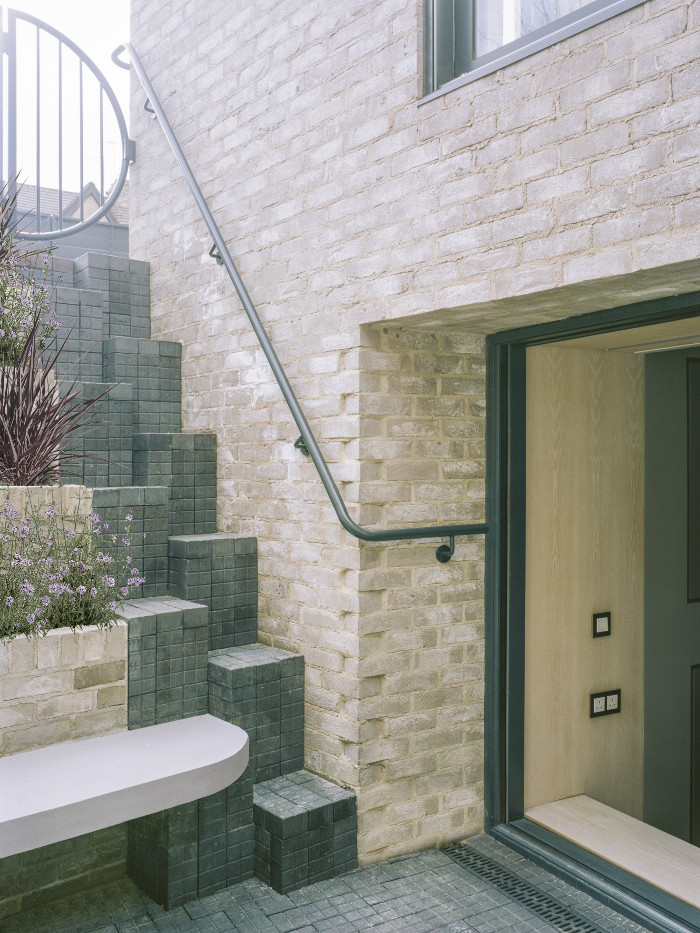
Detail of tiled steps down to basement (Fletcher Crane Architects. Photography: Lorenzo Zandri)
For information about the guidance on this page and how it should be applied, visit Using this SPD.
Where proposals deviate from the guidance here, the Council will need to be satisfied that proposals are high quality and not detrimental to neighbourhood amenity. Pre-application submission is encouraged.
Converted basement, with stepped access and planting (Paper House Project. Photography: French & Tye)
7.10 Basement additions and alterations
Basement development includes any excavation to form new or additional floorspace under the ground level or garden of an existing home. The creation of a new basement is likely to be unfeasible in most locations, due to associated risks, including increased risk of flooding.
7.10.1
For details of permitted development rights for basement works to houses, refer to this page on the Planning Portal. Planning permission is not usually required to convert an existing basement into a living space. However, the creation of a new basement usually requires planning permission.
7.10.2
Basement additions and extensions are generally not considered acceptable. However, proposals may be considered in exceptional circumstances where proposals are of exemplar design quality and proposed in areas that are not at risk of flooding.
7.10.3
For planning permission applications, submission of a Basement Impact Assessment (BIA) is required. This is a technical report assessing the potential effects of the proposal on the site and surrounding area, covering aspects including drainage, flooding, groundwater and structural stability.
7.10.4
If the basement abuts the public highway, an Approval in Principle (AIP) document must be submitted and approved as a planning condition prior to commencement of construction. Please note the applicant will need to pay for the cost of an external review.
7.10.5
If the proposal is in an area at risk of flooding, a Flood Risk Assessment must also be submitted to address susceptibility to groundwater flooding, depth of water table, and any other relevant considerations in relation to flooding.
7.10.6
Basement proposals should carefully consider windows, outlook and daylight. Any proposed lightwells should be well-designed, which may involve the inclusion of grilles or railings, to mitigate the visual impact of the lightwell on streetscene.
7.10.7
If a lightwell to the front of the property is proposed, at least 50% of the existing front garden space should be retained. This is to limit the impact to visual amenity, as supported by Policy 57 of the Local Plan, ‘Amenity’. Minimising areas of hard surfacing in front gardens also helps to mitigate local flood risk - read more about garden materials here.
Detail of tiled steps down to basement (Fletcher Crane Architects. Photography: Lorenzo Zandri)
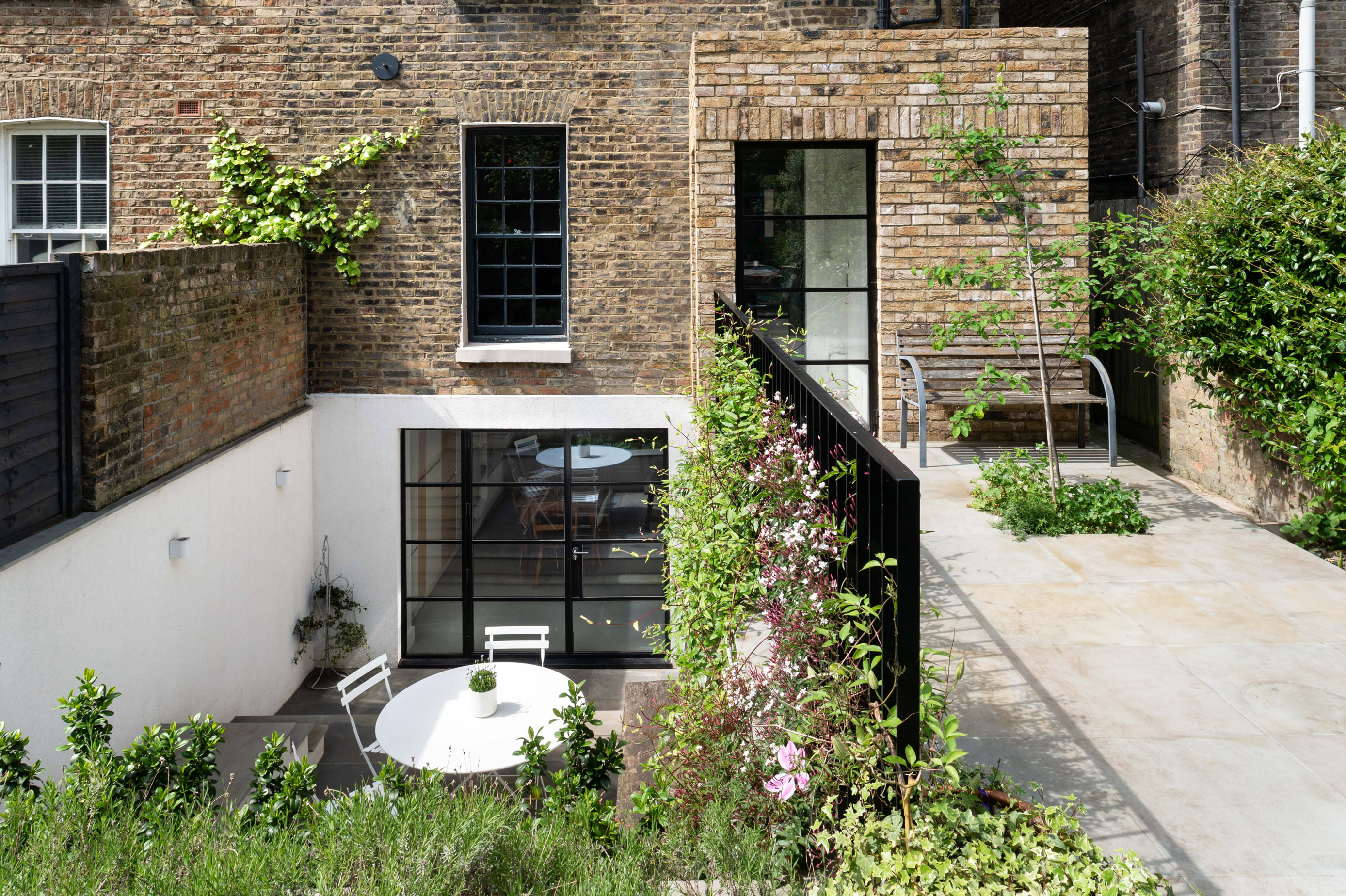 Converted basement, with stepped access and planting (Paper House Project. Photography: French & Tye)